
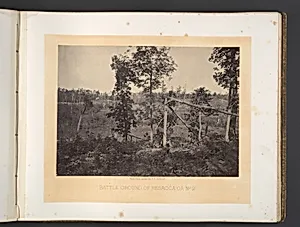
Battle Ground of Resacca, Georgia No. 2
1860s
Medium
Albumen silver print from glass negative
Classification
Photographs
Department
Photographs
Museum
Metropolitan Museum of Art, New York, NY
Credit
Pfeiffer and Rogers Funds, 1970
Accession Number
1970.525 (20)
Rights
Public Domain
Tags
Art Historical Context
Step into the scarred landscapes of the American Civil War with George N. Barnard's *Battle Ground of Resacca, Georgia No. 2*, an evocative albumen silver print from the 1860s. Captured from a glass negative, this photograph depicts the desolate aftermath of the fierce Battle of Resaca in May 1864, a pivotal clash in General William T. Sherman's Atlanta Campaign. Barnard's lens reveals churned earth, abandoned fortifications, and the haunting stillness of a once-chaotic battlefield in northern Georgia, offering a stark visual testament to the war's toll on the Southern terrain. As a pioneering photographer for the Union Army, Barnard documented Sherman's March to the Sea and its prelude, producing some of the earliest comprehensive photographic records of the conflict's physical devastation. His work transcends mere documentation, blending landscape artistry with historical urgency—albumen prints, prized for their luminous detail and warm tones, brought the war's grim reality into sharp focus for Northern audiences, shaping public perception far beyond newspaper sketches. Housed in The Metropolitan Museum of Art's Photographs Department, this image underscores photography's emergence as a powerful medium in the 1860s, immortalizing fleeting moments of destruction and resilience. A poignant reminder of division and endurance, it invites reflection on how landscapes bear silent witness to human strife.
About the Artist
George N. Barnard · 1819–present
George N. Barnard (1819–1902) was a pioneering American photographer whose six-decade career spanned the dawn of the medium, from daguerreotypes to Civil War documentation. Born into a farming family in Coventry, Connecticut, on December 23, 1819, he lost his father at age seven and apprenticed in family businesses before marrying in 1843 and relocating to Oswego, New York. There, he launched one ...