
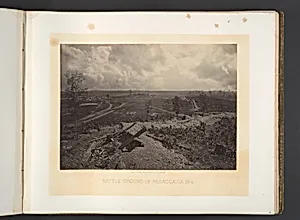
Battle Ground of Resacca, Georgia No. 4
1860s
Medium
Albumen silver print from glass negative
Classification
Photographs
Department
Photographs
Museum
Metropolitan Museum of Art, New York, NY
Credit
Pfeiffer and Rogers Funds, 1970
Accession Number
1970.525 (22)
Rights
Public Domain
Tags
Art Historical Context
Step into the scarred landscapes of the American Civil War with *Battle Ground of Resacca, Georgia. 4*, a poignant albumen silver print by George N. Barnard from the 1860s. Captured in Georgia's Resaca battlefield—a key site in General William T. Sherman's 1864 Atlanta Campaign—this photograph is part of Barnard's acclaimed series documenting the Union's march through the South. As an official photographer for Sherman's army, Barnard transformed desolate fields and fortifications into haunting visual testimonies, offering museum visitors a direct glimpse into the war's toll on the land. The Battle of Resaca, fought May 13–15, 1864, pitted Union forces against Confederate defenders along the Western & Atlantic Railroad, marking a pivotal clash that delayed but did not halt Sherman's advance toward Atlanta. Barnard's image, likely showing the aftermath of artillery fire and troop movements, underscores the Civil War's evolution into total war, where landscapes became battlegrounds. Crafted as an albumen silver print from a glass negative, this medium—popular in the 19th century for its rich tonal depth and sharp detail—allowed Barnard to preserve fleeting scenes with remarkable fidelity. Housed in the Metropolitan Museum of Art, it exemplifies early war photography's role in shaping public memory, blending artistry with unflinching historical record.
About the Artist
George N. Barnard · 1819–present
George N. Barnard (1819–1902) was a pioneering American photographer whose six-decade career spanned the dawn of the medium, from daguerreotypes to Civil War documentation. Born into a farming family in Coventry, Connecticut, on December 23, 1819, he lost his father at age seven and apprenticed in family businesses before marrying in 1843 and relocating to Oswego, New York. There, he launched one ...