
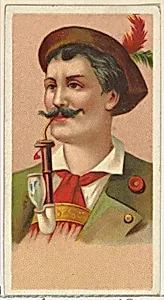
Bavarian Hunter, printer's sample from World's Smokers series (N33) for Allen & Ginter Cigarettes
1888
Medium
Commercial color lithograph
Dimensions
Sheet: 2 3/4 x 1 1/2 in. (7 x 3.8 cm)
Classification
Prints|Ephemera
Department
Drawings and Prints
Museum
Metropolitan Museum of Art, New York, NY
Credit
The Jefferson R. Burdick Collection, Gift of Jefferson R. Burdick
Accession Number
63.350.202.33.5
Rights
Public Domain
Tags
Art Historical Context
Step into the vibrant world of 19th-century advertising with *Bavarian Hunter*, printer's sample from Allen & Ginter's *World's Smokers* (N33), issued in 1888. by the pioneering American tobacco company Allen & Ginter, this tiny chromolithograph—measuring just 2¾ x 1½ inches—was designed as an insert for cigarette packs. It captures a rugged Bavarian hunter, pipe in hand, embodying the era's fascination with folk costumes and exotic European archetypes amid America's booming consumer culture. Chromolithography, the medium here, revolutionized commercial printing with its vivid, multi-layered colors achieved through sequential stone printing. Allen & Ginter, innovators in trade cards and inserts, used such ephemera to build brand loyalty and spark collecting fever among smokers—mostly men at the time. This piece reflects late Victorian ideals of masculinity, leisure, and global wanderlust, turning everyday tobacco promotion into pocket-sized art. Today, housed in the Metropolitan Museum of Art's Jefferson R. Burdick Collection, it highlights the intersection of commerce, design, and popular culture. A delightful glimpse into how cigarettes fueled not just habits, but a visual revolution in everyday imagery.
About the Artist
Allen & Ginter
Allen & Ginter, the pioneering American tobacco firm based in Richmond, Virginia, emerged around 1880 from the partnership of John F. Allen and Lewis Ginter, evolving from Allen's earlier John F. Allen & Company. Allen retired in 1882, succeeded by John Pope, yet the brand endured under Ginter's leadership, employing over 1,100 workers—mostly women—for hand-rolled cigarettes by 1886. Ginter, a Dut...