
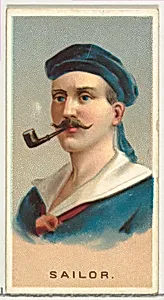
Sailor, from World's Smokers series (N33) for Allen & Ginter Cigarettes
1888
Medium
Commercial color lithograph
Dimensions
Sheet: 2 3/4 x 1 1/2 in. (7 x 3.8 cm)
Classification
Prints|Ephemera
Department
Drawings and Prints
Museum
Metropolitan Museum of Art, New York, NY
Credit
The Jefferson R. Burdick Collection, Gift of Jefferson R. Burdick
Accession Number
63.350.202.33.51
Rights
Public Domain
Tags
Art Historical Context
Step into the vibrant world of 19th-century advertising with *Sailor, from World's Smokers series (N33)*, produced the pioneering tobacco firm Allen & Ginter in 1888. This petite commercial color lithograph2 3/4 1 1/2 in.) was one of many collectible cards inserted into packs, enticing smokers with glamorous depictions of professions puffing on their products. The rugged sailor embodies the era's romanticized seafaring archetype—adventurous, masculine, and ever-ready with a smoke—capturing the Gilded Age fascination with global exploration and tobacco culture. Chromolithography, the medium here, revolutionized mass printing by layering vivid colors through multiple stone plates, making high-quality illustrations affordable for everyday consumers. Allen & Ginter, led by innovator John Allen and merchant Lewis Ginter, spearheaded this trend, transforming ephemera into coveted collectibles that fueled a trading card craze among adults and children alike. Housed in The Metropolitan Museum of Art's Jefferson R. Burdick Collection, this card highlights smoking's once-normalized role in American life, from docksides to drawing rooms. A tiny window into commerce, artistry, and social norms, it reminds us how everyday objects shaped cultural icons.
About the Artist
Allen & Ginter
Allen & Ginter, the pioneering American tobacco firm based in Richmond, Virginia, emerged around 1880 from the partnership of John F. Allen and Lewis Ginter, evolving from Allen's earlier John F. Allen & Company. Allen retired in 1882, succeeded by John Pope, yet the brand endured under Ginter's leadership, employing over 1,100 workers—mostly women—for hand-rolled cigarettes by 1886. Ginter, a Dut...