
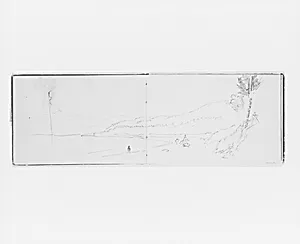
Bay, Hill, and Figure on Shore (from Sketchbook X)
Medium
Graphite on off-white wove paper
Dimensions
5 x 7 1/2 in. (12.7 x 19.1 cm)
Classification
Drawing
Culture
American
Department
The American Wing
Museum
Metropolitan Museum of Art, New York, NY
Credit
Purchase, Gifts in memory of Stephen D. Rubin, 1992
Accession Number
1992.2.2g verso
Rights
Public Domain
Tags
Art Historical Context
Nestled within William Trost Richards' *Sketchbook X*, this intimate 1885 graphite drawing on off-white wove paper a serene coastal vista: a tranquil bay, a rolling hill, and a solitary figure on the shore. Measuring just 5 x 7½ inches, its modest scale invites close inspection, revealing the artist's masterful use of graphite to evoke texture and depth—from the gentle curve of the shoreline to the subtle shading of distant forms. Richards (1833–1905), a prominent American landscape artist associated with the Hudson River School, was renowned for his precise, naturalistic depictions of nature, often sketched en plein air during travels along the Northeast coast. This work exemplifies his meticulous technique, blending Pre-Raphaelite attention to detail with Luminist clarity of light and atmosphere. As a study from his sketchbook, it likely served as preparation for larger oil paintings or watercolors, highlighting his disciplined process of observing and recording the American landscape. Housed in The Metropolitan Museum of Art's American Wing, this piece underscores the cultural importance of 19th-century American artists' fascination with their environment, bridging Romanticism and emerging Realism. A quiet gem, it reminds us of the sketch's power to distill nature's poetry in a single sheet.
About the Artist
William Trost Richards · 1833–1905
William Trost Richards (1833–1905) was a prominent American landscape and marine painter born in Philadelphia, where he attended Central High School before beginning his artistic training. Between 1850 and 1855, he studied part-time under the German-born Hudson River School artist Paul Weber while working as a designer and illustrator of ornamental metalwork. He exhibited his first works at the Pe...