
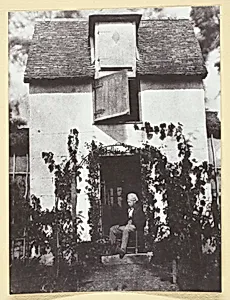
Bayard, Devant sa Maison
1842/50, printed 1965
Medium
Gelatin silver print, No. 25 from the portfolio "Bayard: XXV Calotypes, 1842-1850" (1965)
Dimensions
Image/paper/mount: 21.9 × 16.4 cm (8 5/8 × 6 1/2 in.)
Classification
photographic process
Department
Photography and Media
Museum
Art Institute of Chicago
Accession Number
23820
Rights
Public Domain
Art Historical Context
Hippolyte Bayard, a French pioneer photography, created this intimate portrait of himself standing before his sometime between 1842 and 1850. at the dawn of the, Bayard experimented alongside like Louis Daguerre and William Henry Fox Talbot. He developed his own direct-positive process on paper and embraced the calotype technique, which used paper negatives to produce softer more atmospheric images than the sharp daguerreotype. This gelatin silver print comes from a 1965 portfolio that reproduced twenty-five of Bayard’s original calotypes, preserving works that might otherwise have faded. The modest scale—roughly 8 by 6 inches—reflects the intimate, personal nature of early photography, when practitioners often turned their lenses on their own surroundings rather than grand subjects. The photograph captures both the quiet domestic world of its maker and the experimental spirit that helped transform photography from scientific curiosity into an expressive art form. Today it stands as a rare, firsthand record of one inventor’s life at the very beginning of photographic history.
About the Artist
Hippolyte Bayard · 1801–1887
Hippolyte Bayard (1801–1887) was a French civil servant and artist who holds a remarkable, if bittersweet, place in the history of photography: he was one of the independent inventors of the photographic process in the late 1830s, developing his own direct positive paper print method at virtually the same moment that Louis Daguerre and William Henry Fox Talbot were arriving at their own solutions ...