
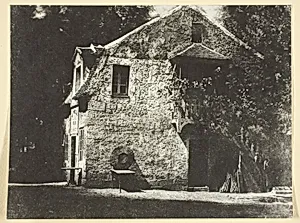
Le Moulin: Paul Restauranteur
1842/50, printed 1965
Medium
Gelatin silver print, No. 6 from the portfolio "Bayard: XXV Calotypes, 1842-1850" (1965)
Dimensions
Image/paper/mount: 17.2 × 22.8 cm (6 13/16 × 9 in.)
Classification
photographic process
Department
Photography and Media
Museum
Art Institute of Chicago
Accession Number
23762
Rights
Public Domain
Art Historical Context
Hippolyte Bayard, a pioneering French photographer, created the negative for *Le Moulin: Paul Restauranteur* between 1842 and 1850, during the earliest years of the medium. As one of the inventors of photography, Bayard experimented with paper-based processes that allowed for multiple prints, distinguishing his approach from the unique daguerreotype. This gelatin silver print, produced in 1965 as part of the portfolio *Bayard: XXV Calotypes*, brings a rare surviving image from that formative period to modern viewers. The modest dimensions of 17.2 × 22.8 cm reflect the intimate scale of early photographic work, while the title hints at a quiet French scene featuring a mill and a restaurateur named Paul. Bayard’s calotypes capture the textures of everyday life with a soft, atmospheric quality characteristic of paper negatives, offering a window into mid-nineteenth-century France. Housed in the Art Institute of Chicago’s Department of Photography and Media, this work underscores photography’s rapid evolution from experimental process to recognized art form. It invites contemplation of how Bayard’s vision helped shape the medium’s artistic potential.
About the Artist
Hippolyte Bayard · 1801–1887
Hippolyte Bayard (1801–1887) was a French civil servant and artist who holds a remarkable, if bittersweet, place in the history of photography: he was one of the independent inventors of the photographic process in the late 1830s, developing his own direct positive paper print method at virtually the same moment that Louis Daguerre and William Henry Fox Talbot were arriving at their own solutions ...