
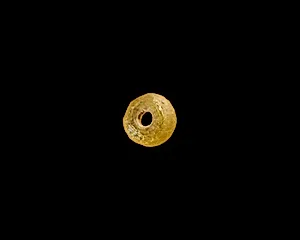
Bead
1550-1196 BCE
Classification
Jewelry and Ornament
Department
Smithsonian Collection
Museum
Smithsonian American Art Museum
Credit
Gift of Charles Lang Freer
Accession Number
F1909.1369
Rights
Public Domain
Tags
About this artwork
To 1909
Art Historical Context
This unassuming yet exquisite glass bead transports us to ancient Egypt's New Kingdom (ca. 1550–1196 BCE), an of monumental achievements under pharaohs like Hatshepsut and Ramses II. Dating to this dynamic period, the bead exemplifies everyday artistry from a civilization renowned for its innovation in materials and craftsmanship. Produced during the height of Egyptian glassmaking—introduced around 1500 BCEsuch beads were molded or shaped from vibrant, colorful glass rods, showcasing advanced techniques like core-forming or winding for precision and durability. In ancient Egyptian culture, glass beads held profound significance beyond mere ornamentation. Worn in necklaces, bracelets, and amulets, they symbolized status, protection, and spiritual power, often incorporating faience or semi-precious stones in jewelry ensembles. This example, classified as jewelry and ornament, reflects the democratization of luxury: while reserved for elites in palaces and tombs, beads circulated widely through trade across the Mediterranean. Acquired by collector Charles Lang Freer by 1909 and gifted to the Smithsonian, this bead now graces the Smithsonian American Art Museum's collection. Though small, it whispers tales of Nile Valley ingenuity, inviting us to marvel at the enduring sparkle of antiquity.
About the Artist
Unknown
The artist designated as "Unknown" in our virtual museum's collection exemplifies a poignant chapter in art history: creators whose identities have faded into obscurity despite the enduring power of their work. With only one known artwork attributed to them in our holdings, this figure represents countless anonymous hands that shaped visual culture across centuries. Museums worldwide, including th...