
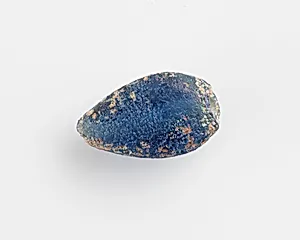
Bead
1st-2nd century
Classification
Jewelry and Ornament
Department
Smithsonian Collection
Museum
Smithsonian American Art Museum
Credit
Gift of Charles Lang Freer
Accession Number
F1909.1449
Rights
Public Domain
Tags
About this artwork
To 1909
Art Historical Context
This delicate glass bead, dating to the 1st-2nd century during Egypt's Roman Period (30 BCE–395 CE), the everyday artistry of ancient Egyptian jewelry. Crafted in an era when Egypt blended its Pharaonic traditions with Roman following Cleopatra's time, such beads were ubiquitous in personal adornments, necklaces and amulets. Worn by people across social classes, they symbolized status, protection, or simply beauty, highlighting the culture's enduring love for vibrant, portable ornaments. The bead's iridescent sheen—likely resulting from centuries of burial and natural weathering—is a captivating hallmark of ancient glasswork. Egyptian glassmakers were pioneers, employing sophisticated techniques like core-forming or molding to create translucent, colorful objects from silica sands. This piece reflects their mastery, as glass production thrived under Roman rule, fueling trade across the Mediterranean. A treasured part of the Charles Lang Freer collection, acquired by 1909 and gifted to the Smithsonian American Art Museum, this bead offers a tangible link to antiquity. Though small, it whispers stories of daily life in Roman Egypt, inviting us to marvel at the ingenuity of artisans whose work still shimmers today.
About the Artist
Unknown
The artist designated as "Unknown" in our virtual museum's collection exemplifies a poignant chapter in art history: creators whose identities have faded into obscurity despite the enduring power of their work. With only one known artwork attributed to them in our holdings, this figure represents countless anonymous hands that shaped visual culture across centuries. Museums worldwide, including th...