
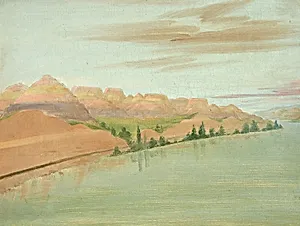
Beautiful Clay Bluffs, 1900 Miles above St. Louis
1832
Medium
Painting
Classification
Painting
Department
Smithsonian Collection
Museum
Smithsonian American Art Museum
Credit
Smithsonian American Art Museum, Gift of Mrs. Joseph Harrison, Jr.
Accession Number
1985.66.382
Rights
Public Domain
Tags
About this artwork
“These curious bluffs must be seen as they are in nature; or else in a painting, where their colours are faithfully given, or they lose their picturesque beauty, which consists in the variety of their vivid tints. The strata of clay are alternating from red to yellow---white---brown and dark blue; and so curiously arranged, as to form the most pleasing and singular effects.” George Catlin painted this scene during a voyage along the Missouri River in 1832. (Catlin, Letters and Notes, vol. 1, no....
Art Historical Context
In 1832, American artist George Catlin embarked on an ambitious voyage up the Missouri River, determined to document the untamed landscapes and Native American cultures of the American West before they vanished under waves of settlement. *Beautiful Clay Bluffs, 1900 Miles above St. Louis* captures one such mesmerizing vista: dramatic riverbank formations of vividly layered clay strata in reds, yellows, whites, browns, and dark blues. Catlin himself marveled at their "picturesque beauty," insisting in his *Letters and Notes* that only nature or a faithful painting could convey their singular tints and effects. As a pioneering figure in 19th-century American art, Catlin employed a realist style infused with Romantic wonder, using oil paints to replicate the bluffs' geological splendor with remarkable precision. This work exemplifies his mission to create an visual archive of the frontier, blending scientific observation with artistic passion. Today, housed in the Smithsonian American Art Museum, it invites us to ponder the fleeting beauty of the pre-industrial Plains, a testament to America's wild heart.
About the Artist
George Catlin · 1796–1872
George Catlin (1796–1872), born in Wilkes-Barre, Pennsylvania, to Putnam Catlin and Polly Sutton—who had been captured by Native Americans during the 1778 Battle of Wyoming—initially pursued a legal career. Trained at Litchfield Law School, he was admitted to the bar in 1819 but abandoned law after two years to study art in Philadelphia in 1823. Self-taught as a portraitist, Catlin quickly gained ...