
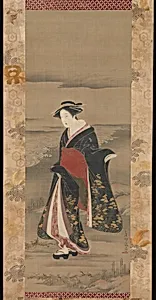
Beauty by the Shore
18th century
Medium
Hanging scroll; ink and color on paper
Dimensions
Image: 32 x 11 15/16 in. (81.3 x 30.3 cm) Overall: 63 7/8 x 18 3/4in. (162.2 x 47.6 cm)
Classification
Paintings
Culture & Period
Japan · Edo period (1615–1868)
Department
Asian Art
Museum
Metropolitan Museum of Art, New York, NY
Credit
The Harry G. C. Packard Collection of Asian Art, Gift of Harry G. C. Packard, and Purchase, Fletcher, Rogers, Harris Brisbane Dick, and Louis V. Bell Funds, Joseph Pulitzer Bequest, and The Annenberg Fund Inc. Gift, 1975
Accession Number
1975.268.127
Rights
Public Domain
Tags
Art Historical Context
"Beauty by the Shore" is a captivating hanging scroll by Kubo Shunman, a prominent Japanese artist of the late Edo period (1615–1868). in the 18th century, this measures 32 x 11 15/16 inches in image area and exemplifies Shunman's mastery in ukiyo-e, the "pictures of the floating world" style that celebrated fleeting pleasures like beauty and nature. Rendered in ink and color on paper it likely portrays an elegant woman poised by the water's edge, evoking the refined grace of bijin-ga (images of beauties) popular among Edo Japan's urban elite. Hanging scrolls like this were designed for intimate display in private homes, unrolled for contemplation during tea gatherings or seasonal viewings, highlighting their role in personal cultural expression. Shunman's technique blends delicate ink lines with vibrant colors, capturing the subtle interplay of light on waves and fabric, a hallmark of Edo painting that bridged traditional literati styles with emerging print culture. This piece reflects the period's prosperity and fascination with feminine allure amid natural serenity. Today, housed in the Metropolitan Museum of Art's Asian Art Department as part of The Harry G. C. Packard Collection (1975), it invites visitors to appreciate Japan's artistic legacy of harmony between humanity and the ephemeral seashore.
About the Artist
Kubo Shunman · 1757–1820
Japanese, 1757–1820