
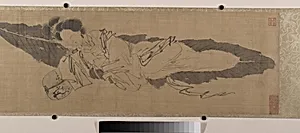
明 佚名 唐寅(僞款) 蕉葉仕女圖 卷|Beauty Sleeping on a Banana Leaf
Medium
Handscroll; ink on silk
Dimensions
Image: 8 × 24 1/4 in. (20.3 × 61.6 cm)
Classification
Paintings
Culture & Period
China · Ming dynasty (1368–1644)
Department
Asian Art
Museum
Metropolitan Museum of Art, New York, NY
Credit
From the Collection of A. W. Bahr, Purchase, Fletcher Fund, 1947
Accession Number
47.18.129
Rights
Public Domain
Tags
Art Historical Context
This exquisite Ming dynasty handscroll, titled *Beauty Sleeping on a Banana Leaf*, captures a moment of quiet repose through delicate ink washes on silk. Created in the traditional Chinese handscroll format, the work invites intimate viewing as it is gently unrolled, revealing the reclining figure nestled against the broad, curving leaf. The medium allows for subtle gradations of tone that evoke both the softness of fabric and the natural texture of the plant, highlighting the artist’s sensitivity to line and atmosphere. Although bearing a spurious inscription linking it to the celebrated Wu School painter Tang Yin, the scroll is catalogued as anonymous, reflecting common practices of attribution in later centuries. Tang Yin himself was renowned for his elegant figure paintings that blended literati refinement with graceful depictions of women, often drawing on poetic themes of beauty and transience. Here, the subject resonates with longstanding Chinese literary motifs of fleeting moments and harmony with nature. Acquired by the Metropolitan Museum of Art in 1947 from the renowned collector A. W. Bahr, the painting exemplifies the enduring appeal of Ming figure studies. Its modest scale and lyrical composition continue to offer viewers a serene glimpse into classical ideals of elegance and contemplation.
About the Artist
Tang Yin · 1470–1524
Talented painter whose career as an official painter was ruined by an examination scandal in 1499. Around 1500 he began to study painting with Zhou chen. He was ultimately considered one of the Four Masters of the Ming, along with Shen Zhou, Wen Zhengming and Qiu Ying.