
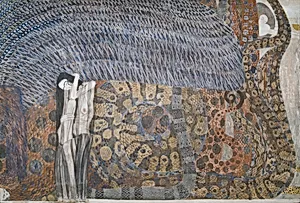
Beethovenfries: Die feindlichen Gewalten - Tafel 2, Stirnwand
1901/1902
Medium
Kaseinfarben, Stuckauflagen, Zeichenstift, Applikationen aus verschiedenen Materialien (Glas, Perlmutt etc.), Goldauflagen auf Mörtel
Dimensions
215 x 315,5 cm
Classification
Wandbild
Department
Belvedere Collection
Museum
Belvedere
Credit
Belvedere, Vienna
Accession Number
5987/6
Rights
Public Domain
About this artwork
Vor dem Schlangenkörper des Giganten Typhaeus hockt die Figur des "Nagenden Kummers".
Art Historical Context
Gustav Klimt's *Beethovenfries: feindlichen Gewalten Tafel 2, Stirnwand* (1901/1902) is a captivating panel from his monumental *Beethoven Frieze*, originally created for the Vienna Secession's 14th exhibition in1902. This vast mural cycle, inspired by Beethoven's Ninth Symphony, unfolds a mythological narrative of humanity's struggle against hostile forces, blending Symbolism and Art Nouveau in Klimt's signature ornate. As a leader of the Secession movement, Klimt rebelled against academic art, favoring decorative exuberance and psychological depth. Measuring 215 x 315.5 cm, this wall painting (*Wandbild*) depicts the snake-bodied giant Typhaeus, with the poignant figure of "Gnawing Sorrow" crouching before him—a vivid embodiment of despair amid cosmic conflict. Klimt's innovative mixed-media technique shines here: casein paints, stucco reliefs, ink drawings, and lavish applications of gold leaf, glass, and mother-of-pearl on mortar create a shimmering, jewel-like surface that draws viewers into its otherworldly drama. Housed in Vienna's Belvedere Collection, the frieze remains a pinnacle of Viennese Modernism, symbolizing early 20th-century quests for spiritual renewal. Its tactile opulence and mythic intensity continue to mesmerize, inviting us to confront inner turmoil through art's transformative power.
About the Artist
Gustav Klimt · 1862–1918
Gustav Klimt was born on July 14, 1862, in Baumgarten near Vienna, the second of seven children in a modest family of artistic bent. His father, Ernst Klimt, a gold engraver who had immigrated from Bohemia, and his mother, Anna Finster, an aspiring musician, instilled an early appreciation for craft and creativity amid financial hardship. Klimt displayed prodigious drawing talent, prompting his en...