
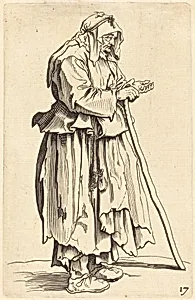
Beggar Woman Receiving Charity
1622 or later
Medium
etching on laid paper
Dimensions
sheet (trimmed to plate mark): 14.2 × 9.3 cm (5 9/16 × 3 11/16 in.)
Classification
Department
CG-E
Museum
National Gallery of Art, Washington, D.C.
Credit
Rosenwald Collection
Accession Number
1949.5.328
Rights
Public Domain
Art Historical Context
This poignant etching, *Beggar Woman Receiving Charity is created after the renowned French artist Jacques Callot, dating to 1622 or. Callot, a master printmaker of the Baroque era, was celebrated for his vivid depictions of social outcasts, particularly in his influential series *Les Gueux (The Beggars), produced around 1622–1623. Captured on a modest scale—trimmed to just 14.2 × 9.3 cm—this intimate print portrays a moment of human kindness amid hardship, reflecting the stark realities of poverty in 17th-century Europe, where economic strife and urban beggary were commonplace. Etched on laid paper, the work showcases Callot's revolutionary etching technique, which used a hard-ground method to achieve extraordinary fine lines and intricate details in small formats. This allowed for mass production and wide dissemination of socially observant scenes, making art accessible beyond elite patrons. Housed in the National Gallery of Art's Rosenwald Collection (Department CG-E), it exemplifies the print medium's power to document and evoke empathy for the marginalized. Today, this piece invites visitors to ponder timeless themes of charity and inequality, its delicate lines whispering stories of resilience in an unforgiving world.
About the Artist
after Jacques Callot
**Jacques Callot (c. 1592–1635)**, the master whose designs inspired the works attributed "after Jacques Callot," was a pioneering French Baroque printmaker and draftsman born in Nancy, capital of the independent Duchy of Lorraine (now northeastern France). From a noble family—his father served as master of ceremonies and herald-at-arms to the Duke of Lorraine—young Callot was apprenticed to a gol...