
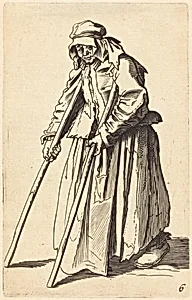
Beggar Woman with Crutches
1622 or later
Medium
etching on laid paper
Dimensions
plate: 13.9 × 8.2 cm (5 1/2 × 3 1/4 in.) sheet: 14.5 × 9.4 cm (5 11/16 × 3 11/16 in.)
Classification
Department
CG-E
Museum
National Gallery of Art, Washington, D.C.
Credit
Rosenwald Collection
Accession Number
1949.5.321
Rights
Public Domain
Art Historical Context
This poignant etching, *Beggar Woman with Crches*, is created after the renowned French artist Jacques Callot and dates to 1622 or later.ot, a master printmaker of the Baroque era, was celebrated for his intricate depictions of everyday life, particularly the marginalized poor. This small-scale work (plate measures just 13.9 × 8.2 cm) likely draws from his famous *Beggars* series (*Les Gueux*), whichized society's outcasts amid the social upheavals of early 17th-century Europe, including the aftermath of the Thirty Years' War. Etched on laid paper—a traditional support prized for its texture and absorbency—the print showcases Callot's virtuoso technique. Etching allowed for delicate, expressive lines that capture the woman's weary posture, crutches, and ragged attire with empathetic realism. As a reproductive print "after" Callot, it reflects the era's booming market for affordable art copies, making high artistry accessible beyond the elite. Housed in the National Gallery of Art's Rosenwald Collection, this piece invites reflection on poverty's enduring face, blending technical brilliance with social commentary in a format that revolutionized visual storytelling.
About the Artist
after Jacques Callot
**Jacques Callot (c. 1592–1635)**, the master whose designs inspired the works attributed "after Jacques Callot," was a pioneering French Baroque printmaker and draftsman born in Nancy, capital of the independent Duchy of Lorraine (now northeastern France). From a noble family—his father served as master of ceremonies and herald-at-arms to the Duke of Lorraine—young Callot was apprenticed to a gol...