
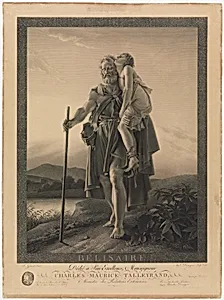
Medium
Engraving with etching
Dimensions
Plate: 21 3/4 x 15 7/8 in. (55.2 x 40.4 cm) Sheet: 23 5/16 x 17 5/16 in. (59.2 x 43.9 cm)
Classification
Prints
Department
Drawings and Prints
Museum
Metropolitan Museum of Art, New York, NY
Credit
Gift of Paul Spiegel on behalf of Mel D. Spiegel, 1973
Accession Number
1973.662
Rights
Public Domain
Tags
Art Historical Context
"Belisarius" (1806) is a engraving with etching by Auguste Gaspard Louis Bouchernoyers, reproducing a composition by the esteemed Neoclassical painter Baron François Gérard. Housed in the Metropolitan Museum Art's Drawings and Prints, this print measures an impressive plate size of 21 3/4 x 15 7/8 inches (55.2 x 40.4 cm). Generously gifted in 1973 by Paul Spiegel on behalf of Mel D. Spiegel, exemplifies the era's reproductive printmaking, blending engraving's fine lines with etching's tonal depth to capture dramatic narratives for a wide audience. The subject draws from the life of Flavius Belisarius, the 6th-century Byzantine general celebrated for reconquering vast territories for Emperor Justinian I, only to face betrayal, blinding, and beggary in old age. Gérard's scene poignantly evokes this fall from grace, featuring generals, men, boys, and snakes—elements that heighten the tension of loyalty, recognition, and perhaps treachery amid ruins. Rendered during the Napoleonic era, it reflects Neoclassicism's fascination with heroic antiquity and moral lessons. Through its intricate technique, the print democratized Gérard's emotional intensity, inviting 19th-century viewers to ponder fortune's reversals. A timeless reminder of glory's fragility, it remains a gem for those exploring history's human dramas.
About the Artist
baron François Gérard|Auguste Gaspard Louis Boucher Desnoyers · 1770–1837
**Baron François Gérard (1770–1837)** was a leading French Neoclassical painter renowned for his elegant portraits of European royalty and political figures. Born François Pascal Simon Gérard in Rome to a French father serving in the Papal States and an Italian mother, he returned with his family to Paris around 1782. There he began his artistic training, first studying sculpture under Augustin Pa...