
Belt Buckle
Unknown Artist
7th century
Medium
Iron, silver inlay, copper alloy
Dimensions
Overall: 5 1/2 x 2 5/8 x 13/16 in. (14 x 6.7 x 2 cm)
Classification
Metalwork-Iron
Culture
Frankish
Department
Medieval Art
Museum
Metropolitan Museum of Art, New York, NY
Credit
Gift of J. Pierpont Morgan, 1917
Accession Number
17.192.235
Rights
Public Domain
Art Historical Context
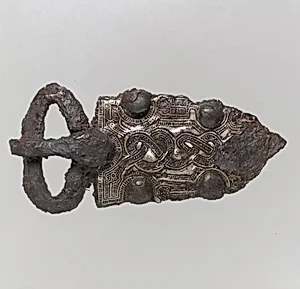
This exquisite Frankish belt buckle from the 7 century exemplifies the masterful metalwork of early medieval Europe during the Merovingian period Crafted from iron with intricate silver inlay and copper alloy, it measures a compact 5½ x 2⅝ x 13/16 inches (14 x 6.7 x 2 cm), yet its robust form and decorative detailing suggest it adorned a high-status belt, symbolizing wealth and power among the Frankish elite. Such accessories were not mere fasteners but emblems of identity, bridging late Roman traditions with emerging Germanic styles. The buckle's construction highlights advanced techniques like silver inlay—possibly niello or damascening—where precious metals were meticulously embedded into the iron base for shimmering contrast. This labor-intensive process reflects the Frankish workshops' skill in blending durability with ornamentation, influenced by trade routes spanning the Mediterranean and northern Europe. As Christianity spread under rulers like Clovis, these objects often carried subtle motifs evoking protection or prestige. A generous gift from J. Pierpont Morgan to The Metropolitan Museum of Art in 1917, this piece invites us to envision a warrior or noble striding through 7th-century Gaul, their buckle glinting in the firelight—a tangible link to a transformative era.