
Belt Buckle Attachment Plate
Unknown Artist
late 5th century
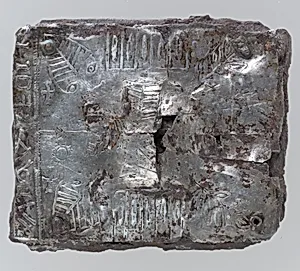
Medium
Iron, repoussé silver sheet overlay; copper alloy posts
Dimensions
Overall: 2 7/16 x 2 1/16 x 5/16 in. (6.2 x 5.3 x 0.8 cm)
Classification
Metalwork-Iron
Culture
Frankish
Department
Medieval Art
Museum
Metropolitan Museum of Art, New York, NY
Credit
Gift of J. Pierpont Morgan, 1917
Accession Number
17.192.166
Rights
Public Domain
Art Historical Context
This exquisite Belt Buckle Attachment Plate, crafted by an unknown Frankish artisan in the late 5th century, offers a glimpse into the early Medieval world of the Franks, a Germanic people who rose to prominence in post-Roman Gaul. Measuring just over 2 inches across, this small yet sophisticated metalwork piece—made of iron with a repoussé silver overlay and copper alloy posts—was likely part of a warrior's or elite's belt ensemble, symbolizing status and craftsmanship during the Merovingian era. The repoussé technique, where silver was hammered from the reverse to create raised designs, highlights the advanced metalworking skills of Frankish artisans. This method allowed for intricate decoration on a durable iron core, blending functionality with artistry. Such buckles were not mere fasteners but emblems of cultural identity, reflecting the fusion of Germanic traditions with lingering Roman influences as the Frankish kingdom expanded under leaders like Clovis I. Today, housed in the Metropolitan Museum of Art's Medieval Art department thanks to a 1917 gift from J. Pierpont Morgan, this artifact reminds us how everyday objects preserved the artistry of a transformative age, bridging antiquity and the Middle Ages.