
Benham
Medium
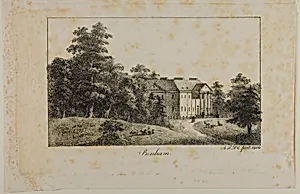
Two lithographs in black on cream wove paper, printed on the same sheet
Dimensions
Image: 16 × 26.9 cm (6 5/16 × 10 5/8 in.); Sheets: 48.5 × 36.7 cm (19 1/8 × 14 1/2 in.)
Classification
lithograph
Department
Prints and Drawings
Museum
Art Institute of Chicago
Accession Number
39869
Rights
Public Domain
Art Historical Context
Visitors to the Art Institute of Chicago's Prints and Drawings department will encounter *Benham*, a captivating pair of lithographs created in 1806 by Antoine Philippe dléans, a French prince and amateur artist from the illustrious House of Orléans. Born in 1775, d'Orléans was brother to the future King Louis Philippe I and pursued art amid the turbulent post-Revolutionary era. This work, featuring two images in black ink on cream wove paper printed on a single large sheet (48.5 × 36.7 cm), measures 16 × 26.9 cm per image—compact yet evocative. Lithography, invented just a decade earlier by Alois Senefelder, marked a revolutionary planographic technique using greasy crayons on polished limestone slabs. D'Orléans's adoption of this nascent medium in 1806 highlights its rapid spread among European artists for its ability to mimic drawing's fluidity and tonal subtlety, bridging fine art and reproducible prints. As one of the earliest examples, *Benham* showcases the process's potential for precise, expressive lines on wove paper, prized for its smooth texture ideal for detailed printing. Though specifics of the subject "Benham"—possibly a portrait, landscape, or named figure—remain elusive, the work's royal provenance and technical innovation underscore lithography's role in democratizing art during Napoleonic France. A testament to aristocratic creativity in a time of political upheaval, it invites us to appreciate how nobility embraced modernity.