
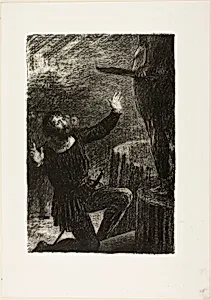
Benvenuto Cellini, Act III: The Casting of Perseus
Medium
Lithograph in black on ivory China paper laid down on white wove paper
Dimensions
Image: 22.7 × 15.4 cm (8 15/16 × 6 1/8 in.); Sheet: 30.7 × 21.6 cm (12 1/8 × 8 9/16 in.)
Classification
lithograph
Department
Prints and Drawings
Museum
Art Institute of Chicago
Accession Number
44101
Rights
Public Domain
Art Historical Context
Henri Fantin-Latour's *Benvenuto Cellini, Act: The Casting of Per* (1888) is a masterful lithograph capturing a pivotal moment in the life of the flamboyant 16th-century Italian Renaissance Benvenuto Cellini. Part of Fantin-Latour's series illustrating Théophile Gautier's play about Cellini, this print depicts the dramatic climax of casting Cellini's iconic bronze statue *Perseus with the Head ofusa* (1545–1554) in Florence. Cellini's autobiography vividly recounts the peril—molten metal nearly destroying the foundry—forcing him to smash the furnace himself to save the work, embodying Renaissance ingenuity and bravado. Fantin-Latour, a leading French Realist lithographer influenced by Ingres and Delacroix, brings this historical episode to life with exquisite precision. Printed in black ink on delicate ivory China paper laid down on white wove support, the medium allows for subtle tonal gradations and intricate details, mimicking the intensity of flickering furnace light and straining figures. At just 22.7 × 15.4 cm, its intimate scale draws viewers into the tension, highlighting lithography's role in 19th-century France as a democratic art form for reproducing literary and historical narratives. Held in the Art Institute of Chicago's Prints and Drawings collection, this work celebrates Cellini's enduring legacy while showcasing Fantin-Latour's technical virtuosity, bridging Renaissance drama with modern printmaking innovation.
About the Artist
Henri Fantin-Latour · 1836–1904
Ignace Henri Jean Théodore Fantin-Latour was born on January 14, 1836, in Grenoble, France, to portrait painter Théodore Fantin-Latour, who gave him his earliest drawing lessons. The family relocated to Paris in 1841, where in 1850, at age 14, he enrolled in the École de Dessin, studying under Horace Lecoq de Boisbaudran, whose innovative memory-based method of drawing from observation profoundly ...