
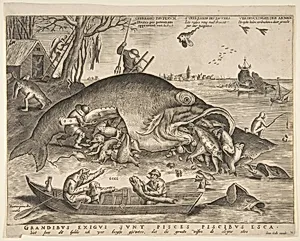
Big Fish Eat Little Fish
Medium
Engraving; fourth state of four
Dimensions
Plate: 9 1/16 × 11 13/16 in. (23 × 30 cm) Sheet: 9 1/2 × 11 7/8 in. (24.2 × 30.1 cm)
Classification
Prints
Department
Drawings and Prints
Museum
Metropolitan Museum of Art, New York, NY
Credit
Harris Brisbane Dick Fund, 1953
Accession Number
53.601.14(58)
Rights
Public Domain
Tags
Art Historical Context
Created in 1557, *Big Fish Eat Fish* is an engraving a design by Pieter Brgel the Elder, one of the most inventive artists of the Northern Renaissance. Although Bruegel conceived the image, it was skillfully cut into a copper plate by engraver Pieter van der Heyden and published by Joannes Galle. The resulting print allowed Bruegel’s witty moral commentary to reach a wide audience across Europe at a time when original drawings or paintings remained the privilege of wealthy collectors. The scene vividly illustrates the ancient proverb that gives the work its title. Larger fish are shown being gutted to reveal smaller fish inside them, while fishermen haul in their catch on a bustling shore. Through this layered allegory, Bruegel offers a sharp observation on power, greed, and the endless cycle of exploitation—ideas that resonated in the economically competitive world of sixteenth-century Antwerp. As a print, the engraving demonstrates the remarkable detail achievable in the medium: every scale, wave, and expressive face is rendered with precision. Today, the fourth state in the Metropolitan Museum’s collection preserves this enduring message, inviting viewers to reflect on timeless human behaviors.
About the Artist
Pieter Bruegel the Elder|Pieter van der Heyden|Joannes Galle I · 1525–1569
Pieter Bruegel the Elder, a pioneering Netherlandish painter of the Renaissance, was born around 1525–1530, likely in Breda in the Duchy of Brabant (present-day Netherlands). Little is known of his early family background, but he apprenticed under the Antwerp painter and designer Pieter Coecke van Aelst between approximately 1545 and 1550, mastering tapestry design, architecture, and painting tech...