
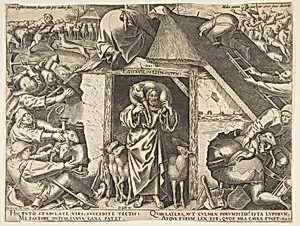
The Parable of the Good Shepherd
Medium
Engraving; fourth state of four
Dimensions
sheet: 8 3/4 x 11 9/16 in. (22.3 x 29.3 cm)
Classification
Prints
Department
Drawings and Prints
Museum
Metropolitan Museum of Art, New York, NY
Credit
Harris Brisbane Dick Fund, 1953
Accession Number
53.601.15(60)
Rights
Public Domain
Tags
Art Historical Context
Created around 1565, *The Parable of the Good Shepherd* a finely detailed engraving designed by Pieter Brgel the Elder and executed engraver Philips Galle Bruegel, celebrated for his keen observations of life and moral themes, interprets the biblical story from Gospel of John, in which Christ compares himself to a shepherd who protects his flock. The fourth state of this print captures a lively countryside scene populated by shepherds, animals, and modest houses, inviting viewers to reflect on themes of guidance and care. Printmaking was especially significant in the sixteenth century, allowing religious and moral messages to reach wide audiences beyond the elite. Galle’s precise linework translates Bruegel’s distinctive Northern Renaissance style—rich in narrative detail and symbolic landscape—into an accessible format. The modest sheet size (roughly 8¾ by 11⅝ inches) made the work easy to own and study at home. Today housed in the Metropolitan Museum of Art’s Department of Drawings and Prints, this engraving exemplifies how Bruegel’s moral vision and Galle’s technical skill together turned a timeless parable into an enduring visual lesson for everyday viewers.
About the Artist
Pieter Bruegel the Elder|Philips Galle · 1525–1569
Pieter Bruegel the Elder, a pioneering Netherlandish painter of the Renaissance, was born around 1525–1530, likely in Breda in the Duchy of Brabant (present-day Netherlands). Little is known of his early family background, but he apprenticed under the Antwerp painter and designer Pieter Coecke van Aelst between approximately 1545 and 1550, mastering tapestry design, architecture, and painting tech...