
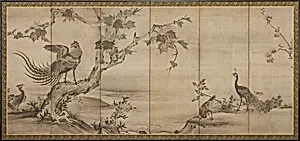
Birds, flowers, and trees: on the back, bamboo trees
1568-1615
Classification
Painting
Department
Smithsonian Collection
Museum
Smithsonian American Art Museum
Credit
Gift of Charles Lang Freer
Accession Number
F1906.263
Rights
Public Domain
Tags
About this artwork
To 1906
Art Historical Context
This enchanting Japanese painting, titled *Birds, Flowers, Trees: On the Back, Bamboo Trees*, to the late 16th to early 17th century (1568–1615), aligning with the vibrant Momoyama period (15731615). Created by unknown artist, it likely graces a traditional format such as a screen or scroll, with one side depicting lively birds amid blooming flowers and lush trees, while the reverse features resilient bamboo groves. These natural motifs are hallmarks of Japanese art, symbolizing harmony, impermanence, and endurance—bamboo for flexibility in adversity, flowers for fleeting beauty. The Momoyama era, a time of political upheaval and unification in Japan, produced bold, decorative works often using vivid mineral pigments and gold leaf to evoke opulence, as seen in castle screens for samurai lords. Though the exact medium is unknown, such paintings typically employed ink and colors on silk or paper, showcasing masterful brushwork that captures the essence of nature's vitality. A prized piece from the Charles Lang Freer collection, it was gifted to the Smithsonian American Art Museum, reflecting Freer's passion for Asian masterpieces. Acquired by 1906, it invites visitors to ponder Japan's poetic bond with the natural world during a transformative age.
About the Artist
Unknown
The artist designated as "Unknown" in our virtual museum's collection exemplifies a poignant chapter in art history: creators whose identities have faded into obscurity despite the enduring power of their work. With only one known artwork attributed to them in our holdings, this figure represents countless anonymous hands that shaped visual culture across centuries. Museums worldwide, including th...