
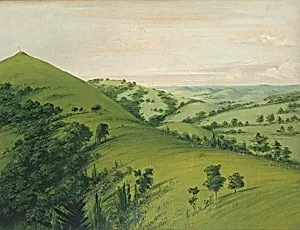
Blackbird's Grave, a Back View, Prairies Enameled with Flowers
1832
Medium
Painting
Classification
Painting
Department
Smithsonian Collection
Museum
Smithsonian American Art Museum
Credit
Smithsonian American Art Museum, Gift of Mrs. Joseph Harrison, Jr.
Accession Number
1985.66.365
Rights
Public Domain
Tags
About this artwork
To suggest the vastness of the Great Plains in his small landscapes, George Catlin often assumed an elevated viewpoint. Blackbird’s grave, a site visited by Lewis and Clark nearly three decades earlier, was the final resting-place of an Omaha chief who had been buried astride his favorite horse. The artist painted this work in 1832 on his first extended voyage up the Missouri River.
Art Historical Context
George Catlin's *Blackbird's Grave, a Back View, Prairies Enameled with Flowers* (1832) captures the sweeping vastness of the Great Plains during the artist's first extended voyage up the Missouri River. A pioneering documentarian of Native American life, Catlin painted this intimate landscape to evoke the boundless American West, using an elevated viewpoint that compresses immense prairies—enameled with vibrant wildflowers—into a compact canvas. As part of his mission to record indigenous cultures before they faded, the work reflects his Romantic style, blending precise observation with a sense of awe for the untamed frontier. The scene centers on the grave of Blackbird, a revered Omaha chief who died around 1802 and was buried astride his favorite horse atop a Missouri River bluff—a tradition noted by Lewis and Clark during their 1804 expedition nearly three decades earlier. This "back view" offers a poignant glimpse into Native burial customs, contrasting the solemn mound against the endless plain, symbolizing both cultural reverence and the encroaching changes of westward expansion. Housed in the Smithsonian American Art Museum, this oil painting exemplifies Catlin's technique for conveying epic scale in small formats, inviting viewers to ponder the fragile harmony between people, horses, and the land in early 19th-century America.
About the Artist
George Catlin · 1796–1872
George Catlin (1796–1872), born in Wilkes-Barre, Pennsylvania, to Putnam Catlin and Polly Sutton—who had been captured by Native Americans during the 1778 Battle of Wyoming—initially pursued a legal career. Trained at Litchfield Law School, he was admitted to the bar in 1819 but abandoned law after two years to study art in Philadelphia in 1823. Self-taught as a portraitist, Catlin quickly gained ...