
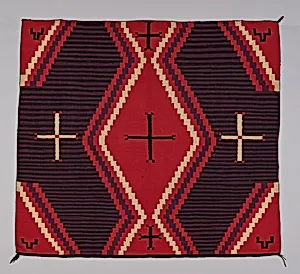
Chief Blanket (Third Phase)
c. 1880
Medium
Wool, dovetail tapestry weave with "lazy lines"; twined warp ends and selvages; corner tassels
Dimensions
141 × 163.2 cm (55 1/2 × 64 1/4 in.)
Classification
blanket (covering)
Department
Textiles
Museum
Art Institute of Chicago
Accession Number
210028
Rights
Public Domain
Art Historical Context
This stunning *Chief Blanket (Third Phase)*, woven by Diné (Navajo) artisans around 1880, exemplifies pinnacle of Navajo weaving mastery. Measuring 141 × 163.2 cm, this wool textile from the Art Institute of Chicago Textiles collection features the intricate geometric patterns characteristic of the Third Phase of Chief Blankets. These evolved from earlier striped designs into bold, stepped motifs, diamonds, and terraced borders, reflecting a sophisticated aesthetic that blended traditional symbolism with emerging commercial influences. Crafted using a dovetail tapestry weave with distinctive "lazy lines"—subtle diagonal shifts where weft colors meet—the blanket showcases expert control over tension and color. Twined warp ends, selvages, and corner tassels add durability and finish, techniques passed down through generations of Navajo women weavers. Wool from local sheep, often dyed with vibrant aniline colors by this era, allowed for the blanket's rich palette and precision. Historically, "Chief Blankets" gained their name from Anglo traders who marketed them to Plains Indian leaders, though they held deep cultural value for the Navajo as trade goods, ceremonial items, and symbols of skill. This Third Phase piece captures a transitional moment in Navajo artistry, bridging pre-contact traditions with 19th-century market demands, inviting visitors to appreciate its timeless beauty and cultural resonance.