
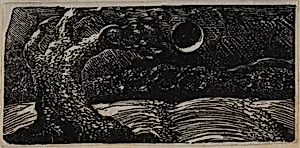
Blasted Tree and Flattened Crops, from The Pastorals of Virgil
1821
Medium
Wood engraving on off-white wove paper
Dimensions
Image/block: 3.4 × 7.3 cm (1 3/8 × 2 7/8 in.); Sheet: 3.6 × 7.4 cm (1 7/16 × 2 15/16 in.)
Classification
wood engraving
Department
Prints and Drawings
Museum
Art Institute of Chicago
Accession Number
87243
Rights
Public Domain
Art Historical Context
In 1821, visionary artist and poet William Blake created *Blasted Tree and Fl Crops* as one of 17 intricate wood engravings for John Thornton's lavish edition of Virgil's *als*. This tiny vignette (just 3.4 × 7.3 cm) captures a dramatic rural scene from the ancient Roman poet's ecloguesidylls of shepherd life—but with Blake's characteristic twist of apocalypse and ruin. A lightning-blasted tree looms over trampled fields, evoking nature's fury amid pastoral serenity, reflecting Romantic anxieties about humanity's fragile harmony with the wild. Blake, a pioneer of relief etching and a key figure in British Romanticism, mastered wood engraving late in life for this project. The medium, carved into end-grain boxwood for fine, precise lines, allowed affordable book reproduction while showcasing his ethereal style—delicate foliage, swirling winds, and symbolic desolation printed on off-white wove paper. These engravings were groundbreaking, blending classical literature with Blake's mystical worldview. Housed in the Art Institute of Chicago's Prints and Drawings Department, this work highlights Blake's enduring influence on illustration, transforming Virgil's timeless verses into haunting visions that resonate today, reminding us of nature's dual power to nurture and destroy.
About the Artist
William Blake · 1757–1827
William Blake (1757–1827) stands as one of the most visionary and unconventional artists in British history, a poet-painter-printmaker whose mystical imagination and radical vision profoundly shaped the Romantic movement. Born in London's Soho district, Blake experienced visions from childhood—claiming to see angels in trees at age eight—and these spiritual encounters would guide his art throughou...