
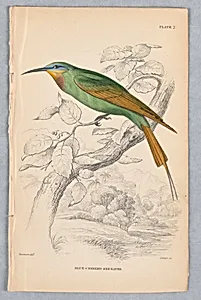
Blue-Cheeked Bee-Eater, Plate 7 from Birds of Western Africa
Medium
Classification
Department
Smithsonian Collection
Museum
Smithsonian American Art Museum
Credit
Gift of Hamill and Barker
Accession Number
1961-105-165
Rights
Public Domain
About this artwork
Research in Progress
Art Historical Context
This vibrant print, created in 1837 by artist and engraver William Home Lizars, captures the Blue-Cheeked Bee-E with remarkable precision. As Plate 7 from the publication *Birds of Western Africa*, the work reflects the 19th-century fascination with natural history and global exploration. Lizars, known for his detailed engravings in ornithological volumes, brought scientific accuracy to life through careful observation of plumage, posture, and habitat. Prints like this played a vital role in sharing knowledge during an era before widespread photography. They allowed scholars, collectors, and the public to study exotic species from distant regions such as Western Africa. Lizars’s technique combines fine line work with subtle coloring, highlighting the bird’s distinctive blue cheeks and slender form against a simple background. Housed in the Smithsonian American Art Museum as a gift of Hamill and Barker, this piece exemplifies how art and science intersected to document the natural world. It invites viewers to appreciate both the beauty of the bee-eater and the artistry behind early scientific illustration.