
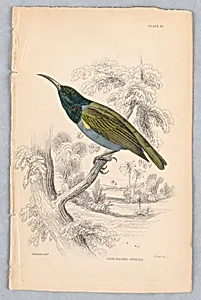
Olive-Backed Sunbird, Plate 16 from Birds of Western Africa
Classification
Department
Smithsonian Collection
Museum
Smithsonian American Art Museum
Credit
Gift of Hamill and Barker
Accession Number
1961-105-174
Rights
Public Domain
About this artwork
Research in Progress
Art Historical Context
William Home Lizars, a Scottish engraver and natural history illustrator, created this delicate print in 1837 as Plate 16 for the publication *Birds of Western Africa*. Lizars specialized in finely detailed reproductive prints that brought scientific specimens to a wider audience during an era of expanding global exploration. His work often appeared in lavishly illustrated volumes that combined artistic precision with emerging ornithological study. As a print, this piece reflects the important role of reproductive media in 19th-century science and education. Such plates allowed naturalists and collectors across Europe and America to study exotic species like the olive-backed sunbird without traveling to distant regions. The sunbird, native to parts of Africa and Asia, would have fascinated viewers with its iridescent plumage and nectar-feeding habits. Today, this work resides in the Smithsonian American Art Museum’s collection through the generosity of Hamill and Barker. It offers a window into the intersection of art, science, and empire, showcasing how artists like Lizars helped document the natural world for both scholarly and public appreciation.