
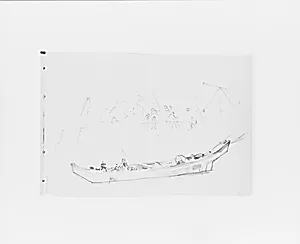
Boat and Encampment (from Sketchbook X)
Medium
Graphite on off-white wove paper
Dimensions
5 x 7 1/2 in. (12.7 x 19.1 cm)
Classification
Drawing
Culture
American
Department
The American Wing
Museum
Metropolitan Museum of Art, New York, NY
Credit
Purchase, Gifts in memory of Stephen D. Rubin, 1992
Accession Number
1992.2.2m recto
Rights
Public Domain
Tags
Art Historical Context
William Trost Richards, a American artist of the late 19th century, *Boat and Encampment (from Sketchbook X)* 1885. This intimate graphite drawing on off-white wove paper5 x 7 1/2 in.) a serene coastal scene featuring a boat moored near a makeshift encampment, evoking the quiet rhythms of everyday life by the water. As part of Sketchbook X, it reflects Richards' meticulous practice of on-site sketching, a hallmark of his career dedicated to precise observations of nature. Richards, influenced by the Hudson River School and John Ruskin's emphasis on truth to nature, was renowned for his hyper-detailed landscapes and seascapes. Graphite sketches like this one served as vital studies for his larger oil paintings and watercolors, showcasing his mastery of line and subtle shading to convey texture—from rippling water to tent fabric. The modest wove paper, smooth and versatile, allowed for fine control, underscoring the technical innovation in American draftsmanship during the Gilded Age. Housed in The Metropolitan Museum of Art's American Wing since its 1992 purchase in memory of Stephen D. Rubin, this work highlights Richards' enduring legacy in celebrating America's natural beauty. Visitors will appreciate its snapshot of 1880s leisure, blending realism with poetic tranquility.
About the Artist
William Trost Richards · 1833–1905
William Trost Richards (1833–1905) was a prominent American landscape and marine painter born in Philadelphia, where he attended Central High School before beginning his artistic training. Between 1850 and 1855, he studied part-time under the German-born Hudson River School artist Paul Weber while working as a designer and illustrator of ornamental metalwork. He exhibited his first works at the Pe...