
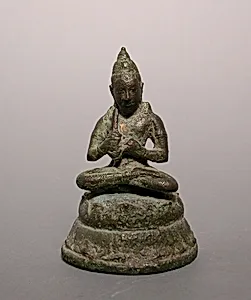
Bodhisattva Manjushri (?)
9th/10th century
Medium
Bronze
Dimensions
9 × 6 × 6 cm (3 1/2 × 2 3/8 × 2 3/8 in.)
Classification
bronze
Department
Arts of Asia
Museum
Art Institute of Chicago
Accession Number
156605
Rights
Public Domain
Art Historical Context
This exquisite bronze sculpture, tentatively identified as the Bodhisattva Manjushri, dates to the 9th or 10th century and stands just 9 cm tall, making it a remarkably intimate devotional object from Asia's rich Buddhist heritage. Housed in the Art Institute of Chicago's Arts of Asia department, it exemplifies the portable art created for personal worship or portable shrines during a golden age of Buddhist iconography. Crafted in bronze—a medium prized for its durability and ability to capture fine details through lost-wax casting—this small figure likely embodies Manjushri, the Bodhisattva of transcendent wisdom, who wields a sword to sever ignorance. Such sculptures were central to Mahayana Buddhist practice, serving as meditative foci in monasteries or homes across regions like India, Nepal, or Tibet. The unknown artist's mastery of proportion and serene expression highlights the era's sophisticated metallurgy and spiritual symbolism. Today, this rare artifact invites visitors to ponder the universal quest for enlightenment, bridging ancient rituals with modern contemplation in the museum's collection.
About the Artist
Unknown
The artist designated as "Unknown" in our virtual museum's collection exemplifies a poignant chapter in art history: creators whose identities have faded into obscurity despite the enduring power of their work. With only one known artwork attributed to them in our holdings, this figure represents countless anonymous hands that shaped visual culture across centuries. Museums worldwide, including th...