
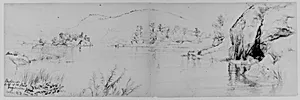
Bog Meadow, West Point, 1871 (from Sketchbook)
ca. 1870
Medium
Graphite on paper
Dimensions
5 1/2 x 8 3/4 in. (14 x 22.2 cm)
Classification
Drawing
Culture
American
Department
The American Wing
Museum
Metropolitan Museum of Art, New York, NY
Credit
Gift of S.B. Luyster, 1936
Accession Number
36.124o verso
Rights
Public Domain
Tags
Art Historical Context
Daniel Huntington's *Bog Meadow, West Point 1871 (frombook)* captures a serene slice of the Hudson River Valley's natural beauty in a compact graphite drawing on paper, measuring just 5½ x 8¾ inches. Created around 1870, this intimate sketch depicts the marshy terrain near the U.S. Military Academy at West Point, a site revered for its strategic and scenic significance along the Hudson. Huntington, a leading American artist and president of the National Academy of Design, was known for his precise, evocative landscapes that echoed the Hudson River School's reverence for the American wilderness. As a page from Huntington's sketchbook, the work showcases the artist's masterful use of graphite to render subtle textures—soft grasses, watery bogs, and distant hills—with fluid hatching and delicate shading. These portable studies were essential tools for 19th-century artists, allowing on-site observation to inform larger paintings or simply preserve fleeting moments of inspiration. Housed in The Metropolitan Museum of Art's American Wing, gifted by S.B. Luyster in 1936, it reflects the era's growing appreciation for everyday American scenes amid post-Civil War national pride. This modest gem invites visitors to appreciate the quiet poetry of place, bridging Huntington's studio practice with the raw allure of the land that shaped American identity.
About the Artist
Daniel Huntington · 1816–1906
Daniel Huntington (1816–1906) was born into a prominent New York family on October 4, 1816, descending from distinguished New England lineage. His early education began at age fourteen at Smith's Academy in New Haven, followed by Yale College, where he studied with Samuel F. B. Morse, the inventor, artist, and president of the National Academy of Design, in 1835. After a disciplinary incident invo...