
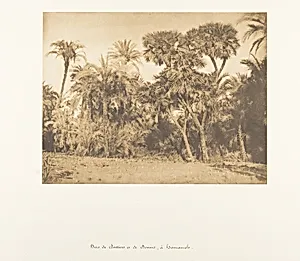
Bois de Dattiers et de Doums, à Hamarneh
1849–50
Medium
Salted paper print from paper negative
Dimensions
Image: 6 3/8 × 8 3/8 in. (16.2 × 21.2 cm) Mount: 12 5/16 × 18 11/16 in. (31.2 × 47.5 cm)
Classification
Photographs
Department
Photographs
Museum
Metropolitan Museum of Art, New York, NY
Credit
Gilman Collection, Gift of The Howard Gilman Foundation, 2005
Accession Number
2005.100.376.36
Rights
Public Domain
Tags
Art Historical Context
In the mid-19th century, French photographer and writer Maxime Du Camp ventured into the heart of the Middle East, capturing some of the earliest photographic images of its landscapes. *Bois de Dattiers et de Doums, à Hamarneh* (1849–50) depicts a serene grove of date palms (dattiers) and doum palms in Hamarneh, likely along the Nile region of Egypt. This salted paper print from a paper negative exemplifies the pioneering calotype process, which allowed for detailed, textured renditions of vast natural scenes, evoking the exotic allure that captivated European audiences during the Orientalist era. Du Camp's journey with novelist Gustave Flaubert from 1849 to 1850 produced over 500 photographs, blending artistic vision with documentary zeal. As one of the first to photograph the Arab world extensively, his work bridged literature and visual culture, influencing how Western viewers romanticized palm-fringed oases as symbols of ancient fertility and timeless beauty. The image's soft tonal range and subtle shadows highlight the calotype's unique grainy aesthetic, a far cry from modern sharpness, underscoring photography's nascent role in preserving ephemeral landscapes. Today, housed in the Metropolitan Museum of Art's Gilman Collection, this print invites us to ponder the dawn of travel photography—where a simple grove becomes a window into 19th-century exploration and cultural exchange.
About the Artist
Maxime Du Camp · 1822–present
Maxime Du Camp (1822–1894) was a pioneering French photographer and writer whose adventurous spirit and technical innovation bridged literature and visual art during the mid-19th century. Born in Paris on February 8, 1822, to a prosperous family—his father a successful surgeon—Du Camp received a solid bourgeois education at the Collège Bourbon (now Lycée Condorcet), where he cultivated interests i...