
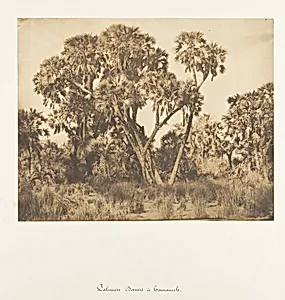
Palmiers Doums à Hamarneh
1849–50
Medium
Salted paper print from paper negative
Dimensions
Image: 6 5/8 × 8 3/8 in. (16.9 × 21.2 cm) Mount: 12 5/16 × 18 11/16 in. (31.2 × 47.5 cm)
Classification
Photographs
Department
Photographs
Museum
Metropolitan Museum of Art, New York, NY
Credit
Gilman Collection, Gift of The Howard Gilman Foundation, 2005
Accession Number
2005.100.376.37
Rights
Public Domain
Tags
Art Historical Context
**Palmiers Doums à Hamarneh** *Maxime Du Camp, 1849–50* Salted paper print from paper, 6 5/8 × 8 3/8 in. (16.9 × 21.2 cm) The Metropolitan Museum of Art, York, Gilman Collection, Gift of Howard Gilman Foundation,2005 Step into the sun-drenched landscapes of mid-19th-century Egypt Maxime Du Camp's *Palmiers Doums à Hamarneh*. Captured during Du Camp's pioneering 1849–50 expedition alongside writer Gustave Flaubert, this photograph depicts the iconic doum palms—tall, fan-leaved trees native to the Nile Valley—at the site of Hamarneh. As one of the earliest photographers to document the Middle East, Du Camp brought distant wonders home, fueling Europe's fascination with Orientalism and ancient civilizations. Printed as a salted paper print from a paper negative, this work exemplifies the calotype process invented by William Henry Fox Talbot. The technique, involving silver iodide on paper sensitized with salt, produced soft, textured images with subtle tonal ranges that captured the play of light on palm fronds beautifully. At just over 6 by 8 inches, its intimate scale invites close viewing, revealing the era's photographic magic before mass-produced prints. This piece holds historical significance as a visual record of Egypt's natural beauty, preserved in the Met's Gilman Collection. It reminds us how photography bridged East and West, transforming palm silhouettes into timeless emblems of exotic allure. (198 words)
About the Artist
Maxime Du Camp · 1822–present
Maxime Du Camp (1822–1894) was a pioneering French photographer and writer whose adventurous spirit and technical innovation bridged literature and visual art during the mid-19th century. Born in Paris on February 8, 1822, to a prosperous family—his father a successful surgeon—Du Camp received a solid bourgeois education at the Collège Bourbon (now Lycée Condorcet), where he cultivated interests i...