
Bolikana and Markolfus
early 16th century; printed 1684
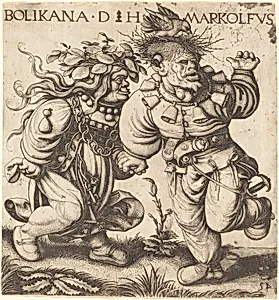
Medium
etching and engraving
Dimensions
sheet: 23.7 × 22.2 cm (9 5/16 × 8 3/4 in.)
Classification
Department
CG-E
Museum
National Gallery of Art, Washington, D.C.
Credit
Ailsa Mellon Bruce Fund
Accession Number
1979.48.7
Rights
Public Domain
Art Historical Context
Daniel Hopfer's *Bolikana and Markus*, an etching and engraving from the early 16 century (printed in 1684), captures the innovative spirit of Northern Renaissance printmaking. Hopfer, a German artist from Augsburg active around 1500–1536, was a goldsmith-turned-printmaker renowned as one of the first to apply etching—a technique involving acid biting into metal plates—to create intricate ironplate prints. This 23.7 × 22.2 cm sheet exemplifies his mastery, blending fine lines from engraving with the fluid tonal effects of etching for vivid, reproducible imagery. In an era when prints revolutionized art dissemination, Hopfer's work bridged decorative arts and fine art, influencing later masters like Albrecht Dürer. The title evokes a narrative scene, possibly drawn from folklore or moral tales popular in Germanic culture, rendered with Hopfer's characteristic detail and whimsy. Its survival through later printings highlights the enduring appeal of these affordable yet sophisticated multiples. Housed in the National Gallery of Art's collection through the Ailsa Mellon Bruce Fund (Department CG-E), this piece invites visitors to appreciate how early modern techniques democratized art, turning personal sketches into shared cultural treasures.
About the Artist
Daniel Hopfer · 1471–1536
Daniel Hopfer (c. 1470–1536), born in Kaufbeuren, was the son of the painter Bartholomäus Hopfer and Anna Sendlerin. He relocated early to Augsburg, becoming a citizen and master painter there in 1493, and trained as an etcher of armor in this thriving center of arms production. By 1505, he owned a house in the city center and served on the guild committee for smiths, which encompassed painters an...