
Bolinka and Marcolfus
late 15th–early 16th century
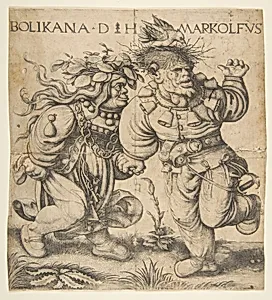
Medium
Etching; fourth state of four
Dimensions
sheet: 9 5/8 x 8 3/4 in. (24.4 x 22.2 cm)
Classification
Prints
Department
Drawings and Prints
Museum
Metropolitan Museum of Art, New York, NY
Credit
The Elisha Whittelsey Collection, The Elisha Whittelsey Fund, 1951
Accession Number
51.501.396
Rights
Public Domain
Tags
Art Historical Context
This etching of *Bolinka and Marcolfus*, produced in the late fifteenth or early sixteenth century, captures the inventive spirit of early printmaking in Renaissance Europe. Created by Daniel Hopfer, a pioneering German artist who helped popularize etching on iron plates, and Hans Weiditz the Younger, the work exists in its fourth and final state. Measuring just under ten inches, the intimate sheet highlights the medium’s ability to render fine lines and textures, allowing artists to move beyond the limitations of woodcuts toward more expressive detail. The subject draws from medieval folklore, featuring the clever peasant Marcolf in dialogue or confrontation with another figure—likely exploring themes of wit, social hierarchy, and moral instruction popular in Northern European culture at the time. Etchings like this one circulated widely, making such stories accessible beyond elite circles and reflecting the growing demand for affordable, reproducible art. Housed in the Metropolitan Museum of Art’s Department of Drawings and Prints, the work exemplifies how technical innovation and storytelling intertwined during this transformative era.
About the Artist
Daniel Hopfer|Hans Weiditz the Younger · 1471–1536
Daniel Hopfer (c. 1470–1536), born in Kaufbeuren, was the son of the painter Bartholomäus Hopfer and Anna Sendlerin. He relocated early to Augsburg, becoming a citizen and master painter there in 1493, and trained as an etcher of armor in this thriving center of arms production. By 1505, he owned a house in the city center and served on the guild committee for smiths, which encompassed painters an...