
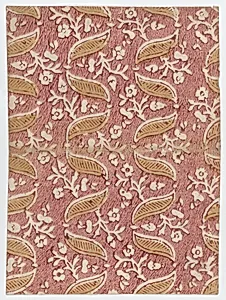
Book cover with overall red floral pattern
18th century
Medium
Relief print (wood or metal)
Dimensions
Sheet: 7 1/8 × 9 11/16 in. (18.1 × 24.6 cm)
Classification
Prints
Department
Drawings and Prints
Museum
Metropolitan Museum of Art, New York, NY
Credit
The Elisha Whittelsey Collection, The Elisha Whittelsey Fund, 1948
Accession Number
48.142.71
Rights
Public Domain
Art Historical Context
This charming 18th-century book, adorned with an overall red floral pattern, exemplifies the artistry of anonymous craftsmen who elevated everyday objects through printed decoration. Created as a relief print—likely from wood or metal—the design features bold, repeating motifs that would have protected and beautified leather-bound volumes during an era when books were prized possessions. Measuring just 7 1/8 × 9 11/16 inches, it fits neatly as a cover for a modest tome, reflecting the practical scale of personal libraries in Europe or colonial America. Relief printing, a technique where ink is applied to raised surfaces carved from a block and pressed onto paper, allowed for efficient production of vibrant patterns. The vivid red hue, achieved through pigments suited to this method, evokes the opulence of floral textiles and wallpapers popular in the Rococo and early Neoclassical periods. Such covers not only shielded books from wear but also signaled taste and status, blending functionality with aesthetic delight. Housed in the Metropolitan Museum of Art's Drawings and Prints department, thanks to The Elisha Whittelsey Collection (acquired 1948), this piece offers a window into the democratizing power of printmaking. It reminds us how anonymous hands crafted beauty for the page-turning public of centuries past.
About the Artist
Anonymous
In the vast tapestry of art history, "Anonymous" stands not as a singular individual but as a collective designation for countless unidentified creators whose works have endured across millennia. These artists, spanning prehistoric cave painters to medieval illuminators and folk craftsmen, produced the foundational layers of human visual culture. Prior to the Renaissance, when individual fame emer...