
Kennet
Design 1883, made 1887
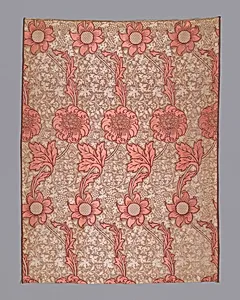
Medium
Silk, satin weave with self-patterning ground wefts
Dimensions
92.8 × 69.6 cm (36 1/2 × 27 3/8 in.); Repeat: 59 × 17 cm (23 1/4 × 6 3/4 in.)
Classification
textile
Department
Textiles
Museum
Art Institute of Chicago
Accession Number
37104
Rights
Public Domain
About this artwork
The Kennet pattern was originally made in three different techniques: woven silk, printed cotton, and printed velveteen. These two silk panels [1971.682a,b] are all that remains of floor-to-ceiling window curtains from the parlor of Glessner House on Prairie Avenue in Chicago.
Art Historical Context
William Morris's *Kennet*, designed in 1883 and in 1887, the Arts and Crafts movement's revival of beauty in everyday objects. As a founding figure of this late-19th-century British movement, Morris rebelled against the mechanized ugliness of the Industrial Revolution, championing handcrafted designs inspired by nature and medieval artistry. Named after the winding River Kennet in England this textile likely evokes flowing organic forms, reflecting Morris's passion for patterns drawn from the natural world. Crafted in silk using a satin weave with self-patterning ground wefts, *Kennet* showcases sophisticated Jacquard loom techniques that Morris adapted to create intricate, repeatable motifs without separate colored threads. The fabric measures 92.8 × 69.6 cm, with a 59 × 17 cm repeat unit ideal for curtains, upholstery, or garments. This medium highlights silk's luxurious sheen and durability, making it a coveted choice for Victorian interiors. Housed in the Art Institute of Chicago's Textiles Department, *Kennet* underscores Morris's enduring influence on design. Through his firm Morris & Co., he democratized artistry, inspiring modern textile traditions and reminding us that even humble fabrics can embody timeless elegance and craftsmanship.
About the Artist
William Morris · 1834–1896
William Morris (1834–1896) was a British designer, craftsman, writer, and socialist activist who became the most influential figure in the Arts and Crafts movement and one of the most important designers in British history. Born in Walthamstow, Essex, he studied at Oxford, where he formed a lifelong friendship with Edward Burne-Jones and came under the influence of John Ruskin's writings on art, l...