
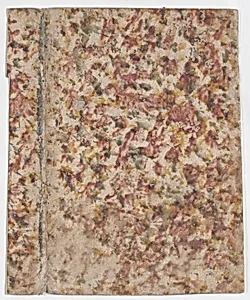
Book cover with overall splotchy pattern
19th century
Medium
Relief print (wood or metal)
Dimensions
Sheet: 8 1/4 × 6 13/16 in. (21 × 17.3 cm)
Classification
Prints
Department
Drawings and Prints
Museum
Metropolitan Museum of Art, New York, NY
Credit
Harris Brisbane Dick Fund, 1939
Accession Number
39.13.94
Rights
Public Domain
Art Historical Context
This unassuming yet charming 19th-century book cover, created anonymously through relief printing on wood or metal, exemplifies everyday artistry of the industrial age. Measuring just 8¼ × 6⅞ inches, its sheet features an overall splotchy pattern—a textured, abstract design that likely served both decorative and protective purposes for bound volumes. Housed in the Metropolitan Museum of Art's Drawings and Prints department, entered the collection via the Harris Brisbane Dick Fund in 1939, highlighting the value placed on humble printed ephemera. Relief printing, the technique used here, involved carving a block so that raised surfaces held the ink, which was then pressed onto paper. This method, efficient and scalable, boomed in the 19th century with advances in mechanized production, enabling publishers to adorn books affordably for a growing literate public. The splotchy motif evokes marbled papers or experimental textures, common in bookbinding to deter counterfeiting or simply add visual appeal. Though anonymous, this piece whispers of broader cultural shifts: as books became accessible commodities, their covers transformed from plain wrappers into miniature artworks, bridging fine art and daily life in Victorian-era society. A delightful glimpse into printing history!
About the Artist
Anonymous
In the vast tapestry of art history, "Anonymous" stands not as a singular individual but as a collective designation for countless unidentified creators whose works have endured across millennia. These artists, spanning prehistoric cave painters to medieval illuminators and folk craftsmen, produced the foundational layers of human visual culture. Prior to the Renaissance, when individual fame emer...