
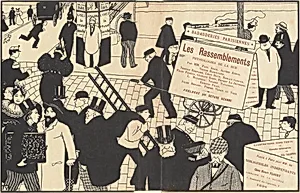
Book jacket for "Les Rassemblements"
1896
Medium
photo-relief
Dimensions
overall: 34.1 x 54.2 cm (13 7/16 x 21 5/16 in.)
Classification
Department
CG-E
Museum
National Gallery of Art, Washington, D.C.
Credit
Virginia and Ira Jackson Collection, gift in memory of Virginia H. Jackson
Accession Number
2006.155.59
Rights
Public Domain
Art Historical Context
Félix Vallotton, Swiss-born artist active in Paris during the 1890s, created this striking book jacket for *Les Rassemblements* in 6. As a key member of the Nabis group—alongside contemporaries like Pierre Bonnard and Édouard Vu—Vallotton was renowned for his bold, graphic style inspired by Japanese woodblock prints. His prints often featured crisp lines, flattened forms, and a dramatic interplay of black and white, capturing modern urban life with incisive social commentary. Printed in photo-relief, a innovative technique combining photography with relief printing, this work (34.1 x 54.2 cm) exemplifies Vallotton's mastery of the medium. Photo-relief allowed for precise tonal gradations from photographic sources, bridging traditional printmaking with emerging photographic processes at the fin-de-siècle. Produced during a vibrant era of French poster art and avant-garde book design, the jacket likely reflects Vallotton's interest in political gatherings and public life, themes he explored amid France's turbulent Dreyfus Affair. Now in the National Gallery of Art's Virginia and Ira Jackson Collection, this print highlights Vallotton's pivotal role in elevating commercial graphics to fine art, influencing modern design and advertising. Visitors will appreciate its timeless elegance and historical snapshot of 1890s cultural ferment.
About the Artist
Félix Vallotton · 1865–1925
Félix Vallotton (1865–1925) was born in Lausanne, Switzerland, into a comfortable middle-class family, and moved to Paris in 1882 to enroll at the Académie Julian, where he studied under the portrait painter Jules Joseph Lefebvre and the history painter Gustave Boulanger. Paris would remain his home for the rest of his life, and he became a French citizen in 1900 following his marriage to the art ...