
Border
1880s/90s
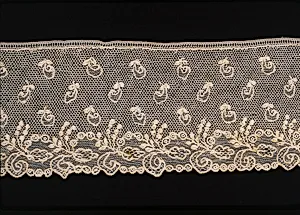
Medium
Linen and horsehair, needle lace of a type known as "Point d'Argentan" with whipped mesh ground
Dimensions
8.7 × 254.9 cm (3 3/8 × 139 5/8 in.); Repeat: W.: 3.2 cm (1 1/4 in.)
Classification
textile
Department
Textiles
Museum
Art Institute of Chicago
Accession Number
110450
Rights
Public Domain
Art Historical Context
Welcome to the Textiles Department at the Art Institute of Chicago where you'll find this exquisite *Border* from the 1880s or 1890s. This narrow linen and horsehair lace strip measures just 8.7 cm high but stretches an impressive 254.9 cm long, featuring a delicate repeating pattern every 3.2 cm. Crafted anonymously by skilled hands, it exemplifies the refined textile arts of the late 19th century, when lace was prized for adorning garments, linens, and furnishings. The piece is a masterful example of "Point d'Argentan," a prestigious needle lace technique originating from Normandy, France. Unlike bobbin laces, needle lace is built stitch by stitch on a paper pattern, allowing for intricate, free-form designs. Here, the whipped mesh ground—created by tightly winding threads around foundation stitches—produces a lightweight, translucent fabric that mimics shimmering silver (hence "Argentan," evoking argent, French for silver). The use of horsehair adds subtle stiffness and sheen, highlighting the lacemaker's precision. In an era of industrial lace production, handmade pieces like this celebrated enduring artisanal traditions, often passed down through generations of women. Though its exact use is unknown, its elegance invites us to appreciate the quiet luxury of Victorian-era needlework, a testament to human ingenuity in fiber arts.
About the Artist
Unknown
The artist designated as "Unknown" in our virtual museum's collection exemplifies a poignant chapter in art history: creators whose identities have faded into obscurity despite the enduring power of their work. With only one known artwork attributed to them in our holdings, this figure represents countless anonymous hands that shaped visual culture across centuries. Museums worldwide, including th...