
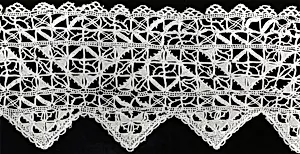
Border (From a Cover)
1550/1600
Medium
Linen, needle lace worked on plain weave cut and drawn thread grid; embroidered in double hem and overcast stitches; two portions joined
Dimensions
10.4 × 98.7 cm (4 1/8 × 38 7/8 in.); Point: W.: 6 cm (2 3/8 in.); Upper band: W.: 6.8 cm (2 5/8 in.); Lower band: W.: 11.3 cm (4 1/2 in.)
Classification
textile
Department
Textiles
Museum
Art Institute of Chicago
Accession Number
38744
Rights
Public Domain
Art Historical Context
This exquisite *Border (From a Cover)*, crafted between 1550 and 1600, hails from the Renaissance era when intricate textiles were prized symbols of wealth and refinement. Likely originating in Europe—possibly Italy or the Low Countries, where lace-making flourished—this narrow linen strip (10.4 × 98.7 cm) served as an ornamental edge for a larger cover, such as aspread, altar cloth, or cassone (chest) lid. Its elongated form and banded widths (varying from 6 to 11.3 cm) suggest it framed a functional yet luxurious household item, showcasing the era's blend of utility and artistry. The piece exemplifies early needle lace techniques, built on a plain weave linen grid where threads were cut and drawn to create an openwork foundation. Delicate embroidery in double hem and overcast stitches adds texture and strength, while the joining of two sections reveals skilled piecing for efficiency. These methods, labor-intensive and requiring exceptional precision, highlight anonymous artisans' mastery—lace was a high-status craft, often rivaling painting in complexity. Today, housed in the Art Institute of Chicago's Textiles Department, this border offers a glimpse into 16th-century domestic splendor. Its preservation underscores lace's evolution from embroidery to standalone art, influencing fashion and interiors for centuries. Visitors can appreciate how such fragile beauties endured, whispering tales of opulent lives long past.
About the Artist
Unknown
The artist designated as "Unknown" in our virtual museum's collection exemplifies a poignant chapter in art history: creators whose identities have faded into obscurity despite the enduring power of their work. With only one known artwork attributed to them in our holdings, this figure represents countless anonymous hands that shaped visual culture across centuries. Museums worldwide, including th...