
Border
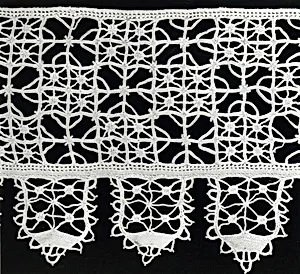
1875/1900 (reproduction of 16th century Reticello design)
Medium
Linen, needle lace worked on plain weave cut and drawn thread work grid; two pieces joined
Dimensions
13.2 × 88.2 cm (5 1/4 × 34 3/4 in.); Repeat: 4.7 × 5.4 cm (1 1/8 × 2 1/8 in.)
Classification
textile
Department
Textiles
Museum
Art Institute of Chicago
Accession Number
38731
Rights
Public Domain
Art Historical Context
This delicate linen border, created between 1875 and 1900 as a faithful reproduction of a 16th-century Reticello design, exemplifies the enduring allure of Renaissance lacework. Measuring a slender 13.2 × 88.2 cm, it consists of two joined pieces featuring a repeating geometric pattern (4.7 × 5.4 cm), perfect for adorning collars, cuffs, or table edges in Victorian-era households. Housed in the Art Institute of Chicago's Textiles Department, it bridges centuries, showcasing how 19th-century artisans revived historic techniques amid a growing fascination with medieval and Renaissance crafts. Reticello, an early form of Italian needle lace, involves meticulously cutting and drawing threads from a plain-weave linen grid to create an open framework, then embellishing it with intricate needle stitches. This labor-intensive process demanded exceptional skill, transforming simple fabric into ethereal, sculptural designs that symbolized wealth and refinement in the 1500s. The reproduction highlights the 19th century's historicist movement, where makers preserved vanishing handicrafts during industrialization. As a textile artifact, this border invites us to appreciate the tactile artistry of lace—its fragility belying the weaver's patience. It reminds visitors of lace's cultural role in fashion and domestic life, evolving from elite status symbols to cherished heirlooms.
About the Artist
Unknown
The artist designated as "Unknown" in our virtual museum's collection exemplifies a poignant chapter in art history: creators whose identities have faded into obscurity despite the enduring power of their work. With only one known artwork attributed to them in our holdings, this figure represents countless anonymous hands that shaped visual culture across centuries. Museums worldwide, including th...