
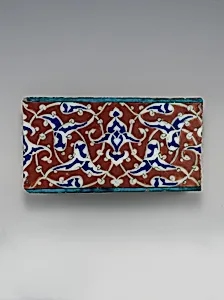
Border Tile with Split-Palmette Design
Unknown Artist
ca. 1578
Medium
Stonepaste; polychrome painted under transparent glaze
Dimensions
H. 5 in. (12.7 cm) W. 9 1/2 in. (24.1 cm) D. 5/8 in. (1.6 cm)
Classification
Ceramics-Tiles
Department
Islamic Art
Museum
Metropolitan Museum of Art, New York, NY
Credit
Fletcher Fund, 1971
Accession Number
1971.235.2
Rights
Public Domain
Art Historical Context
This exquisite *Border Tile Split-Palmette Design*, around 1578, exemplifies the pinnacle of Islamic ceramic artistry from the Ottoman Empire's Iznik workshops in Turkey. Measuring a modest 5 by 9½ inches, this thin stonepaste tile—fired clay mixed with quartz and glass frit for durability and a porcelain-like translucency—was polychrome painted under a transparent. This innovative technique allowed artisans to achieve brilliant blues, turquoise, reds, and greens that have endured for centuries without fading, making it ideal for architectural embellishment. The split-palmette motif, a stylized floral form with symmetrical, curling leaves, draws from Persian influences adapted by Ottoman designers. Such border tiles were essential components of vast mihrab panels, mosque domes, and palace interiors, creating rhythmic friezes that unified larger decorative schemes. Produced during Sultan Murad III's reign, they reflect the empire's cultural zenith, blending technical mastery with spiritual symbolism—palmettes evoking paradise gardens from Islamic tradition. Today, on view in the Metropolitan Museum of Art's Islamic Art galleries (acquired via the Fletcher Fund in 1971), this tile invites visitors to appreciate the anonymous genius behind Iznik's golden age, where everyday surfaces became portals to divine beauty.