
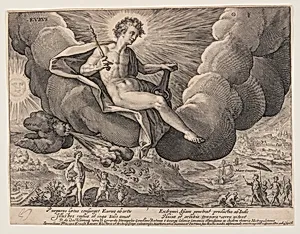
Eurus, from The Winds
c. 1603
Medium
Engraving on ivory laid paper
Dimensions
Sheet (trimmed): 17.8 × 22.9 cm (7 1/16 × 9 1/16 in.)
Classification
engraving
Department
Prints and Drawings
Museum
Art Institute of Chicago
Accession Number
267905
Rights
Public Domain
Art Historical Context
**Eurus, from *The Winds*** Crispijn van de Passe I (c. 1564–1637), a prolific Dutch engraver from a renowned family of artists, created this striking image around 1603 as part of his series *The Winds*. Eurus, the personification of the stormy east wind from classical mythology, embodies the turbulent forces of nature revered in ancient Greek and Roman lore. Produced during the early Dutch Golden Age, when printmaking flourished as a means to share intricate designs across Europe, van de Passe's work reflects the Northern Mannerist style—characterized by elegant lines, dramatic poses, and symbolic depth that bridged Renaissance ideals with emerging Baroque dynamism. This engraving on ivory laid paper, a premium medium prized for its smooth texture and subtle sheen, allowed van de Passe to showcase his mastery of intaglio techniques. Fine burin work captures Eurus's billowing form, wild hair, and swirling winds with remarkable precision, making the sheet (trimmed to 17.8 × 22.9 cm) a portable masterpiece. Engravings like this were collector's items, disseminating mythological motifs to scholars, nobility, and artists hungry for classical inspiration. Housed in the Art Institute of Chicago's Prints and Drawings Department, *Eurus* highlights printmaking's role in democratizing art. It invites us to ponder humanity's enduring fascination with nature's whims, frozen in exquisite detail for generations to admire. (198 words)
About the Artist
Crispijn van de Passe, I · 1565–1637
Crispijn van de Passe the Elder, born around 1564 in the coastal town of Arnemuiden in Zeeland, emerged as a pivotal figure in Northern European printmaking during a turbulent era. He relocated to Antwerp at a young age, the bustling epicenter of engraving, where he trained and worked from 1580 onward, becoming a member of the Guild of Saint Luke in the 1584–1585 guild year. The Spanish siege and ...