
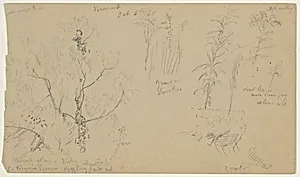
Botanical Sketches, Vermont
October 6, 1865
Classification
Drawing
Department
Smithsonian Collection
Museum
Smithsonian American Art Museum
Credit
Gift of Louis P. Church
Accession Number
1917-4-1134
Rights
Public Domain
About this artwork
Research in Progress
Art Historical Context
Frederic Edwin Church, a leading figure of the Hudson River School, created *Botanical Sketches, Vermont* on October 6, 1865. This drawing captures the artist's keen observation of New England's flora during a period of personal and national reflection, just months after the Civil War's end. Church, renowned for his luminous landscapes like *Niagara* and *Heart of the Andes*, frequently produced on-site sketches to study nature's intricacies, informing his monumental canvases that celebrated America's wild beauty. As a preparatory drawing—its exact medium yet to be determined—these botanical studies exemplify Church's meticulous technique. Hudson River School artists prized such detailed renderings for their scientific precision and romantic reverence for the divine in the everyday, blending art with emerging natural history interests. Sketched in Vermont's lush autumn landscapes, they reflect Church's travels through the Northeast, where he sought inspiration amid personal challenges, including vision loss later in life. Today, housed in the Smithsonian American Art Museum as a gift from Louis P. Church, these sketches offer a intimate glimpse into the master's process. They remind us how humble studies fueled epic visions, bridging 19th-century exploration and artistic legacy. (198 words)