
Bottle
Unknown Artist
7th–8th century
Medium
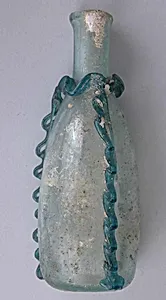
Glass; free blown, applied decoration; tooled on the pontil
Dimensions
H. 3 5/8 in. (9.2 cm) Diam. 1 1/4 in. (3.2 cm)
Classification
Glass
Department
Islamic Art
Museum
Metropolitan Museum of Art, New York, NY
Credit
Museum Accession
Accession Number
x.21.178
Rights
Public Domain
Art Historical Context
This delicate glass bottle, crafted by an unknown artist in the th–8th century exemplifies the refined artistry of early Islamic glass. Hailing from the Islamic world during the Umayyad or Abbasid periods, it stands just 3 5/8 inches tall with a slender 1 1/4-inch diameter—perfectly sized for holding precious perfumes, oils, or medicines. Such vessels were everyday luxuries, traded widely across the Middle East, North Africa, and beyond, highlighting the era's vibrant commerce and cultural exchange. The bottle was free-blown, a technique where molten glass is gathered on a blowpipe and inflated into shape, allowing for elegant, thin-walled forms. Artisans added trails of glass as decoration, then tooled the base on the pontil—a metal rod used to shape the foot while the glass cooled. This method left a characteristic pontil scar, a telltale sign of skilled handcraft before modern machinery. Islamic glassworkers innovated on Roman and Byzantine traditions, favoring transparency and subtle embellishments over heavy engraving. In the Metropolitan Museum of Art's Islamic Art collection, this unassuming bottle whispers of a golden age of craftsmanship, where beauty infused even the smallest objects, bridging utility and artistry in daily life.