
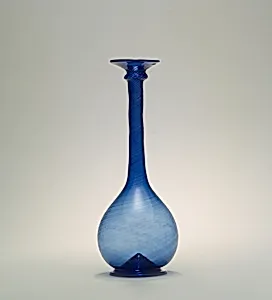
Bottle
Unknown Artist
probably 18th–19th century
Medium
Glass; dip molded with applied decoration, tooled on the pontil
Dimensions
H. 12 1/4 in. (30.6 cm) Max. Diam. 4 11/16 in. (11.9 cm)
Classification
Glass
Department
Islamic Art
Museum
Metropolitan Museum of Art, New York, NY
Credit
Gift of Henry G. Marquand, 1883
Accession Number
83.7.227
Rights
Public Domain
Art Historical Context
This elegant glass bottle, hailing from the Islamic world and likely crafted in the 18th or 19th century, exemplifies refined artistry of traditional glassmaking. Standing at 12¼ inches tall with a maximum diameter of 4⅝ inches, its slender form suggests it was designed as a practical yet luxurious vessel—perhaps for perfumes, oils, or rosewater, common in Ottoman or Persian households. As part of the Metropolitan Museum Art's Islamic Art collection it was generously gifted by Henry G. Marquand in 3, preserving a slice of everyday opulence from a vibrant cultural era. The bottle's creation highlights masterful techniques: dip molding, where molten glass was dipped into a mold for shape; applied decoration, with threads or trails of glass added for texture; and tooled finishing on the pontil, the iron rod used by glassblowers. These methods, widespread in Islamic glass production from the Middle East and beyond, allowed artisans to achieve both functionality and subtle ornamentation without complex enameling. The result is a piece that speaks to the ingenuity of anonymous craftsmen, whose skill turned humble silica into objects of beauty. For visitors, this bottle offers a window into Islamic material culture, where glassware blended utility with aesthetic grace, often reflecting the era's trade networks and technical prowess. Its anonymous origins remind us that true artistry often lay in the hands of skilled workshops rather than named masters.