
Bottle
Unknown Artist
17th century
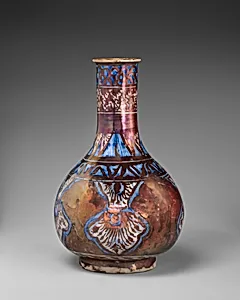
Medium
Stonepaste; luster-painted on opaque white and blue glaze under transparent colorless glaze
Dimensions
Ht. 10 in. (25.4 cm) Diam. 5 1/2 in. (13.9 cm)
Classification
Ceramics
Department
Islamic Art
Museum
Metropolitan Museum of Art, New York, NY
Credit
Edward C. Moore Collection, Bequest of Edward C. Moore, 1891
Accession Number
91.1.169
Rights
Public Domain
Art Historical Context
This elegant 17th-century bottle from the Islamic Art collection at the Metropolitan Museum of Art the refined ceramic traditions of the Islamic world. 10 inches tall with a diameter of 5½ inches, it was crafted from stonepaste—a composite material of quartz, clay, and glass frit—that allowed artisans to create a durable, porcelain-like body prized in regions where true porcelain was unavailable. The bottle's surface features luster-painting on an opaque and blue glaze, finished with a transparent colorless overglaze, producing a shimmering metallic iridescence that catches the light beautifully. Lusterware techniques, originating in 9th-century Iraq and perfected in Persia and Syria, reached new heights in the 17th century under Safavid or Ottoman patronage. The intricate application of metallic oxides fired in a reducing atmosphere created the bottle's glowing effect, symbolizing luxury and technical mastery. Such vessels were often used for perfumes, oils, or as decorative objects in elite households, reflecting the era's blend of functionality and opulence. A gift from the Edward C. Moore Collection in 1891, this anonymous masterpiece invites us to marvel at the anonymous genius of Islamic potters, whose innovations influenced global ceramics for centuries.