
Bottle
Unknown Artist
late 11th–early 12th century
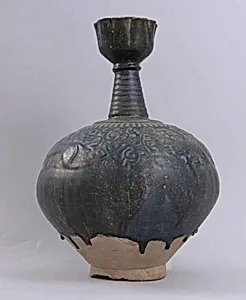
Medium
Artificial paste; molded or carved and glazed
Dimensions
H. 14 1/4 in.. (36.2 cm) Diam. 10 3/8 in. (26.4 cm)
Classification
Ceramics
Department
Islamic Art
Museum
Metropolitan Museum of Art, New York, NY
Credit
Gift of E. Safani, 1968
Accession Number
68.29
Rights
Public Domain
Art Historical Context
This elegant bottle, crafted in the late 11th early 12th century exemplifies the ingenuity of Islamic ceramic artisans during the Seljuk era. Standing 14¼ inches tall with a diameter of 10⅜ inches, it was made from artificial paste—a composite of quartz, clay, and glass frit—molded or intricately carved before glazing. This innovative material, developed in the Islamic world around the 9th century mimicked the prized porcelain of China while allowing for vibrant, translucent glazes that highlighted surface details. Housed in the Metropolitan Museum of Art's Islamic Art Department (gift of E. Safani, 1968), the bottle reflects the technical mastery of potters in regions like Iran or Central Asia. The molding and carving techniques enabled complex motifs, though worn by time, underscoring the object's role in daily luxury—likely for perfumes, oils, or rosewater. Such vessels were status symbols, traded along Silk Road routes, blending utility with artistry. Its survival highlights the enduring legacy of Islamic ceramics, bridging functionality and aesthetics in a golden age of innovation before Europe's porcelain obsession. A quiet testament to forgotten hands, it invites us to appreciate the subtle beauty of medieval craftsmanship.