
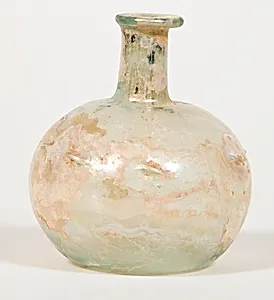
Bottle
5th century
Medium
Glass, blown technique
Dimensions
7.1 × 6.4 × 6.4 cm (2 3/4 × 2 1/2 × 2 1/2 in.)
Classification
bottle
Department
Arts of Greece, Rome, and Byzantium
Museum
Art Institute of Chicago
Accession Number
67516
Rights
Public Domain
About this artwork
Glass vessels were part of the luxurious domestic decoration displayed in wealthy households in both urban villas and rural estates in the later Roman and early Byzantine eras (about 300–725). Glass vessels were used for a variety of purposes, including cosmetic containers. In the kitchen and for dining, pitchers served water and wine, and small cups were used for drinking. Glass was also used for lamps to light the home. Byzantine glass craftsmen improved upon the techniques, forms, and decora...
Art Historical Context
This delicate 5th-century Byzantine bottle, standing just 7.1 cm tall, exemplifies the artistry of the early Byzantine Empire, a period bridging late Roman traditions and the flourishing Christian East Roman world. Crafted using the innovative blown glass technique—perfected centuries earlier in the Levant—this small vessel (7.1 × 6.4 × 6.4 cm) showcases era's mastery of transparency and form, allowing artisans to create lightweight, symmetrical objects with remarkable efficiency. Glassblowing revolutionized production in the Roman and Byzantine periods, enabling mass creation of functional yet elegant items like this bottle, likely used for perfumes, oils, or medicines. Its survival highlights the durability of glass in Mediterranean trade networks, from Constantinople to distant markets. Housed in the Art Institute of Chicago's Department of Arts of Greece, Rome, and Byzantium, it offers a tangible glimpse into everyday Byzantine life, where such unadorned yet precise vessels blended utility with subtle beauty. Though modest in scale, this bottle reflects the Byzantine emphasis on refined craftsmanship amid imperial splendor, reminding us how ordinary objects preserved cultural continuity through turbulent times.
About the Artist
Byzantine
"Byzantine" is the collective attribution given to anonymous artists working within the Eastern Roman (Byzantine) Empire, whose creations spanned from the 4th to the 15th centuries, primarily in Constantinople and its cultural sphere. These masters produced a vast body of art that defined an era, with museums like the Walters Art Museum and the Art Institute of Chicago cataloging numerous works un...